
There is a moment that many North Texas business owners describe almost identically. They have sat through the AI demos and have heard the conference panels as well. They have watched their competitors mention AI in their newsletters as if they already figured it out. And they reach a point where they are done exploring and ready to actually do something about it.
This guide is for that moment.
It is not a list of AI tools or a collection of reasons why artificial intelligence is going to change everything. What this guide covers is the strategic side: how to structure your first ninety days, where the biggest operational gains are happening right now across North Texas industries, what causes most AI initiatives to fall apart before they deliver any value, and how to find a consulting partner who will actually help your business move forward rather than just expand your software subscriptions.
Why the Pressure to Move Is Real — and What Is Driving It
The Dallas-Fort Worth Metroplex has ranked among the top five metro areas in the country for business growth for several years running. That kind of growth environment does not let companies sit still. It creates pressure to process more volume, run leaner operations, and deliver faster results, without proportionally growing headcount or overhead. That is precisely the tension that well-implemented AI is built to resolve.
What has shifted in the last two years is access. The technology infrastructure stretching from Frisco through Plano and into Dallas has brought enterprise-grade AI tools within reach of mid-sized organisations that would have been priced out of them three years ago. A regional logistics company, a growing healthcare practice, a professional services firm with a team of fifteen, all of these organisations can now implement the same category of capabilities that used to require a dedicated IT department and a budget most of them will never have.
The organisations seeing the strongest results from AI adoption in North Texas are not always the largest ones. They are the most disciplined ones, the ones who chose a specific operational problem, built their first AI workflow around solving that problem precisely, proved the results, and then scaled from there.
"The companies doing best with AI right now are not the ones who built the biggest strategy. They are the ones who built the most focused one."
Where Operational AI Is Producing Measurable Results Across North Texas Industries
The chart below reflects documented first-year results from AI adoption across the major industry sectors operating in the Dallas-Fort Worth area. These are not projections or vendor marketing claims. They represent the operational improvements that structured, strategy-led AI adoption with genuine team training behind it, has produced in real business environments.
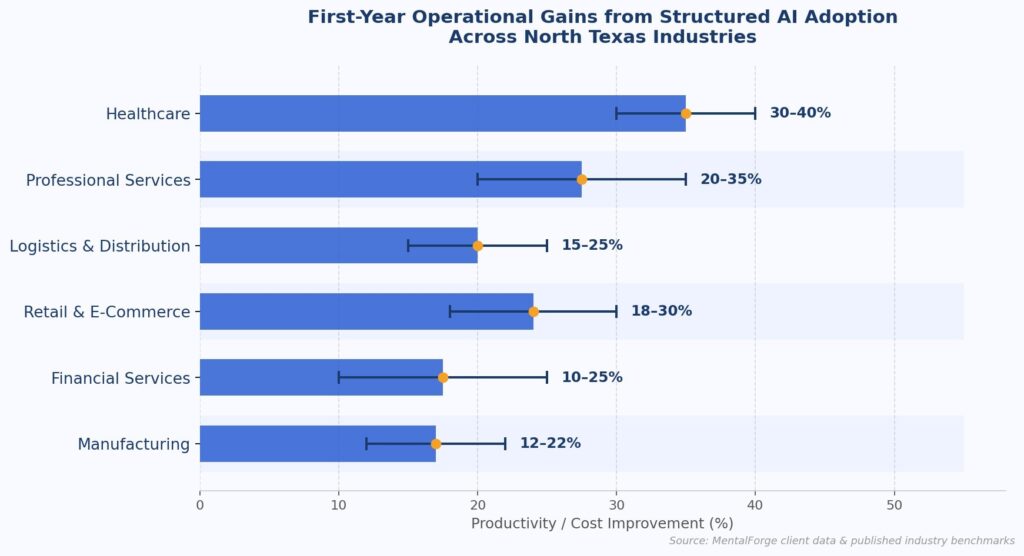
Figure 1: First-year operational gains from structured AI adoption across North Texas industries. Source: MentalForge client data and published industry benchmarks.
Healthcare leads because the administrative overhead in most practices is genuinely enormous, patient intake, scheduling, follow-up communication, insurance documentation and AI addresses all of it without touching clinical judgment. Professional services firms see strong gains because document-heavy workflows are exactly where AI performs most consistently. What every one of these industries shares is the same underlying dynamic: the organisations that hit the higher end of those ranges invested in both the right tools and the structured training to use them well. The ones at the lower end typically did one or the other, not both.
AI Applications by Industry: What Is Actually Running in North Texas Right Now
| Industry | Common AI Application | Reported Operational Benefit |
| Healthcare | Patient intake automation, smart scheduling | 30–40% reduction in admin overhead |
| Professional Services | Document processing, AI-assisted contract review | Faster turnaround, fewer manual errors |
| Logistics & Distribution | Route optimization, real-time demand forecasting | 15–25% reduction in operational costs |
| Retail & E-Commerce | Customer service bots, AI-driven inventory control | Improved response times, lower return rates |
| Financial Services | Fraud pattern detection, automated client reporting | Reduced risk exposure, faster compliance |
| Manufacturing | Predictive maintenance, quality control AI | Less downtime, measurable defect reduction |
Table 1: AI applications and documented operational benefits across major North Texas industry sectors.
If you are looking at that table and trying to figure out where your business falls and what a realistic first implementation could look like, that is exactly what Mental forge's AI integration consulting is designed to help you work out. The process starts with your specific operation, not a generic playbook, and builds from there.
Why Most AI Initiatives Fail Before They Ever Deliver Value
Before you build a plan, it is worth understanding exactly where things go wrong. Most companies that have tried AI and walked away disappointed did not fail because the technology did not work. They failed for one of three very specific and very avoidable reasons.
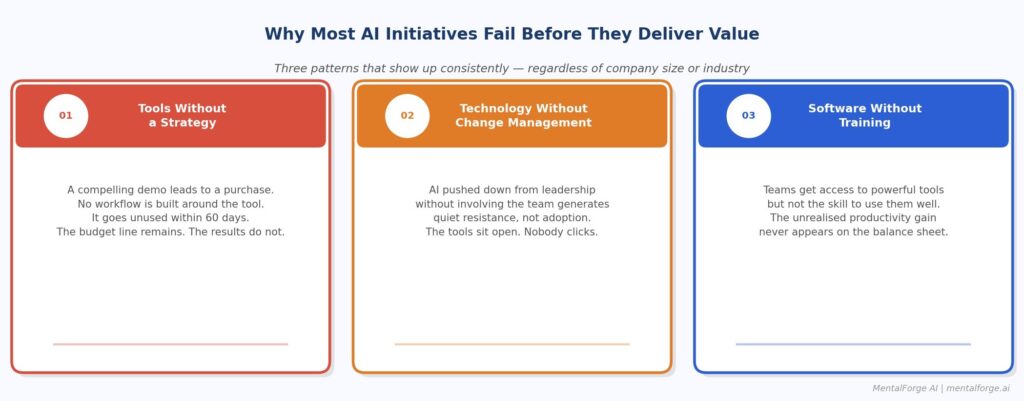
Figure 2: The three failure patterns that consistently derail AI initiatives, regardless of company size, budget, or industry.
Failure Mode 1: Tools Without a Strategy
The most common pattern plays out like this. A business leader sees a compelling demo, buys the tool, deploys it without building a defined workflow around it, and watches the adoption rate quietly collapse within sixty days. The tool was perfectly capable. The business simply never answered the question of how, specifically, it was going to fit into the way their operation actually works day to day. The line item stays on the budget. The results never show up.
Failure Mode 2: Technology Without Change Management
AI pushed down from the leadership level without genuinely involving the team generates something that looks like adoption from the outside and feels like quiet resistance on the inside. The people who need to use these tools every morning have to understand why they are being introduced. They have to feel like their input shaped how the tools fit into their actual work. Skip that process and you end up with software that sits open in browser tabs nobody clicks.
Failure Mode 3: Software Without Training
This is the most expensive failure mode because the cost is almost entirely invisible. A business can deploy a sophisticated AI analytics platform, pay for it every month, and still extract zero operational value from it the moment the team cannot interpret the outputs with confidence or pull AI-generated recommendations into their real decision-making process. The unrealised productivity gain never appears anywhere on the balance sheet.
"Without strategy, change management, and training, all three, not two out of three, even the most capable AI software becomes an expensive reminder that good intentions are not a plan."
Your First 90 Days: A Framework Built Around How Real Adoption Actually Works
The North Texas businesses that are furthest along with AI adoption today did not get there through a single ambitious launch. They ran a tight, well-defined first phase, proved the value clearly against a real baseline, and built from that foundation. The visual below captures what that first phase looks like when it goes well.
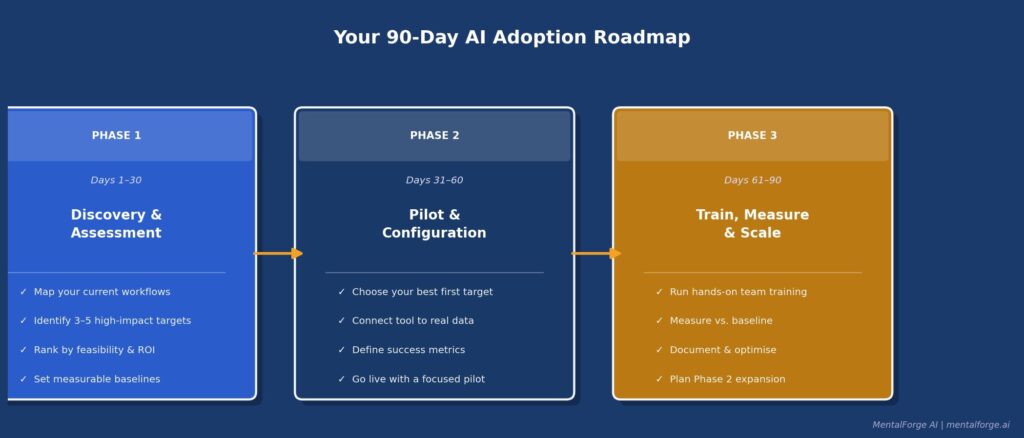
Figure 3: The 90-Day AI Adoption Roadmap — a structured approach to moving from exploration to operational results.
| Phase | Focus | Key Actions |
| Days 1–30 | Discovery & Assessment | Walk your current workflows with fresh eyes. Identify the 3–5 processes that consume the most. |
| Days 31–60 | Pilot & Configuration | Select one use case — your highest-impact, most feasible choice — and build a focused pilot. |
| Days 61–90 | Train, Evaluate & Scale | Run structured training with the people who use this workflow every day — not a one-time. |
Most organisations working through this framework with an experienced consulting partner see documented, measurable results within the first ninety days. That early evidence matters because it changes the internal conversation from 'should we be doing this' to 'what do we tackle next.' The sceptics on your team become advocates. The second phase moves faster and with less friction than the first.
Why Training Is the Variable That Decides Whether Your Investment Pays Off
People drive value from technology but only when they genuinely understand how to use it well in the context of the work they do every day. Most organisations accept this as an obvious principle and consistently underinvest in it when AI rollouts are actually happening.
Effective AI training for North Texas teams goes well beyond a walkthrough of a new interface. It builds genuine operational confidence. Team members learn why the tools work the way they do, how to distinguish between AI output they can act on directly and output that needs human review, and how to keep developing their own skills as the tools evolve over time.
Organisations that invest properly in team training during AI rollouts consistently see stronger adoption rates, shorter time-to-value curves, and substantially lower rates of tool abandonment after the first six months. The technology and the training are not two separate investments, they are two sides of the same decision.
One area where training produces particularly visible and immediate results is in how leaders communicate. The quality of your team's AI prompts is determined almost entirely by the clarity and authority of their natural voice. That is the thinking behind Mental Forge's Brand Voice Architecture programme, which helps business leaders and their teams build the precise, consistent communication style that translates directly into better AI outputs and stronger operational results.
What to Look for in an AI Consulting Partner — and What to Watch Out For
As demand for AI consulting across North Texas has grown, the quality of what is available has varied significantly. Some consulting engagements produce genuine, lasting operational change. Others produce an impressive slide deck, a growing software stack, and a team that is no better equipped than they were before the engagement started.
What a strong consulting partner actually does:
- Starts with a diagnosis of your specific operation, not a product recommendation
- Asks detailed questions about your current workflows before suggesting any tool
- Works within your real budget and timeline, not an idealised version of them
- Measures success by documented operational outcomes, not by tools deployed
- Provides verifiable case studies from businesses comparable to yours in size and industry
- Offers structured support after the initial engagement, not just a handover document
Three questions worth asking before any engagement begins:
- Can you show me specific, verifiable results from a business similar to mine in size and industry?
- What does your involvement look like after the initial engagement ends, and what does ongoing support include?
- How do you define success for this engagement, and how will we measure it together from day one?
Local context matters more than most business leaders initially expect. The operational challenges facing a Fort Worth logistics company are genuinely different from those facing a Frisco financial services firm. A consulting partner with real, hands-on experience working with North Texas businesses brings regional insight that accelerates results in ways a generalist firm simply cannot replicate.
The Bottom Line for North Texas Business Leaders
Artificial intelligence is not a future event that North Texas businesses are waiting for. It is a present-day competitive advantage for the organisations that are approaching it with clarity, discipline, and intention. The companies producing the strongest results right now are not the largest or the most technically sophisticated. They are the most focused, the ones who identified a real operational problem, invested in both the right tools and the training to use them well, and worked with partners who knew how to translate technology capability into actual business results.
The businesses that will look back on this period as a defining moment are not waiting for AI to become simpler or less expensive. They are building the internal capability to use it well right now. The 90-day framework in this guide is your starting point. If you want to work through it with a team that understands what North Texas businesses actually need, the Mental Forge team is ready to help you build it.
"The best time to start was six months ago. The second best time is this week. The framework is here. The decision is yours."
Further Reading
If this guide gave you the strategic framework you needed, the companion piece gives you the human context to go with it. Read How Companies in North Texas Are Using AI to Strengthen Daily Operations, a ground-level look at what AI adoption actually feels like inside real businesses across Dallas, Denton, and Fort Worth, told through the people doing the work.