
Something practical is happening across Dallas, Denton, and Fort Worth that does not always make the headlines. Quietly and steadily, small and mid-size companies in North Texas are doing something that larger corporations have spent years trying to figure out: they are embedding AI directly into the rhythm of their daily work, not as a trend, and not as a one-time experiment, but as a genuine operational shift.
This is not the story of billion-dollar tech firms rolling out AI at scale. This is the story of a logistics coordinator in Denton who cut her weekly reporting time in half. It is the story of a professional services firm in Fort Worth that no longer loses four hours a week to disorganized meeting follow-ups. And it is the story of a healthcare admin team in Dallas that responds to patient inquiries in minutes rather than days.
North Texas AI training has become the bridge between owning AI tools and actually using them well. In this article, we explore the specific ways local businesses are applying AI to strengthen their daily operations, and what it takes to get there.
The Quiet AI Shift Happening Across North Texas Businesses
North Texas has long been a resilient business region, home to a wide mix of industries including logistics, professional services, healthcare administration, real estate, and marketing. What makes the current AI movement particularly meaningful here is that it is driven not by large enterprise budgets, but by business owners and team leaders who are simply tired of doing repetitive, time-consuming work manually.
According to McKinsey's 2024 State of AI report, companies that integrate AI into core business functions see an average productivity gain of 20 to 30 percent within the first year. What North Texas businesses are learning is that you do not need a team of data scientists to access those gains. You need clear direction, the right tools, and structured training that actually makes sense for your work.
The difference between the companies seeing results and those still struggling is rarely about the tools. It is almost always about how well the team understands how to use them in the context of their actual daily responsibilities.
What Operational AI Integration Actually Looks Like
Most conversations about AI start with ChatGPT and end with a vague sense that it could be useful. True operational AI integration looks very different from that.
When a business operationally integrates AI, it means AI becomes part of specific workflows — not an optional extra that employees use when they feel like it. It means the customer service team has a consistent process for using AI to draft and review responses. It means the operations manager uses an AI tool to generate weekly summaries from raw data, rather than writing them from scratch every Friday afternoon.
The key operational areas where North Texas businesses are currently seeing the most impact include internal and external communication, project tracking and reporting, content creation, scheduling, and customer response management. These are not glamorous use cases. They are practical, daily tasks that consume enormous amounts of time when done manually and become surprisingly efficient with the right AI workflow in place.
Real-World AI Use Cases from North Texas Companies
Automating Internal Communication and Leadership Briefing
One of the most overlooked operational drains in any business is internal communication. Managers spend hours every week writing briefs, sending status updates, drafting feedback, and clarifying instructions that could have been clearer the first time. AI is changing that significantly.
Business leaders across North Texas are now using AI to turn their verbal instructions and rough notes into polished, structured written communications. A manager who used to spend forty-five minutes drafting a project brief can now spend ten. The result is not just time saved, it is fewer misunderstandings, faster execution, and teams that feel more clearly directed.
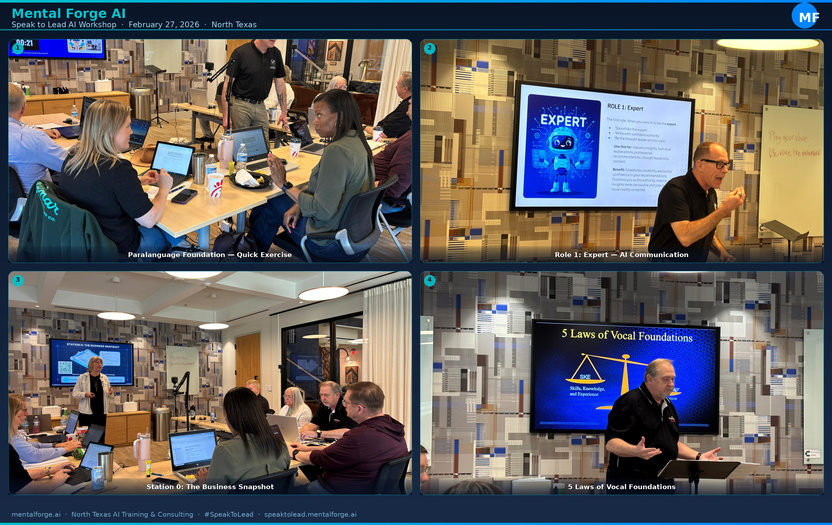
This use case sits at the heart of what the Speak to Lead AI Workshop was built around. Held on February 27th, 2026, this hands-on session helped North Texas managers and founders learn how to convert the way they already brief, coach, and give feedback into AI-ready prompts — without losing their authentic leadership voice. The results from participants were immediate: cleaner communication, faster turnaround, and teams that actually acted on what they were told.
Streamlining Customer-Facing Operations
Customer service teams in North Texas are discovering that AI does not replace human empathy — it removes the friction that gets in the way of it. When a customer emails with a complaint, the last thing your team wants is to spend twenty minutes crafting the perfect response from a blank page. AI can produce a well-structured, warm, and professional first draft in seconds, which your team reviews, personalizes, and sends.
Several service-based businesses in the Dallas area have reported a reduction in average email response time from several hours down to under thirty minutes, simply by integrating AI drafting tools into their customer communication process. The tone remains human. The speed becomes competitive.
Reporting, Scheduling, and Administrative Efficiency
Perhaps the most universally celebrated AI use case among North Texas businesses is the death of the manual report. Whether it is a weekly sales summary, a project status update, or a post-meeting action list, AI tools can now take raw inputs, notes, data, bullet points, and produce clear, structured documents that would previously have taken an hour or more.
Scheduling is another area where AI is earning its place. From coordinating team meetings across time zones to managing customer appointment workflows, AI-assisted scheduling tools are reducing the back-and-forth that eats into productive work hours. Tools like AI-integrated calendar assistants and workflow automation platforms are now accessible to small businesses without the enterprise-level price tags that once made them out of reach.
Why North Texas AI Training Is the Missing Piece for Most Teams
There is a well-documented gap between companies that own AI tools and companies that actually use them to generate results. Research consistently shows that the primary reason AI initiatives fail at the team level is not the technology — it is the absence of structured, practical training.
Giving someone access to a powerful AI tool without showing them how to use it in the context of their specific work is like handing someone the keys to a car and expecting them to race. The tool is capable. The person simply has not been shown what to do with it yet.
Structured North Texas AI training closes that gap. Rather than generic online courses that teach AI theory, effective local training programs focus on role-specific, hands-on sessions where participants learn to use AI tools against real tasks from their actual work. They leave with workflows they can apply the next morning, not concepts they need to figure out how to translate.
This practical shift in approach is exactly what sets results-driven programs apart, and it is a topic explored in depth in the Mental Forge blog post Why North Texas Leaders Are Moving from Generic AI Classes to Integrated Workflow Automation — a must-read for any business owner questioning whether their team is getting the right kind of AI education.
What to Look for in AI Consulting in North Texas
As demand for AI consulting in North Texas has grown, so has the variety of what is available — and not all of it delivers equal value. Some consultants bring impressive technical vocabulary but little practical understanding of what small and mid-size businesses actually need. Others focus so heavily on one tool that they miss the bigger picture of how AI should fit into an organization's existing workflows.
The most effective AI consultants are the ones who start by listening. They want to understand your specific operation before recommending a single tool. They can identify which of your daily tasks are most ripe for AI integration, and they know how to roll out changes in a way that gets team buy-in rather than resistance. Look for consultants who measure success not by how many tools they introduce, but by how measurably your team's output and efficiency improve.
Before engaging any AI consulting service, ask three key questions: Can they demonstrate results from businesses similar to yours in size and industry? Do they offer ongoing support after the initial engagement, not just a one-time session? And can they explain their approach without relying on jargon you have to look up?
How to Start Embedding Operational AI Tools in Your Business This Week
The businesses seeing the fastest results from AI are not the ones who tried to change everything at once. They are the ones who started with one process, proved the value, and expanded from there. Here is a practical three-step framework to begin:
- Identify: Choose one repetitive task your team performs daily or weekly that involves writing, organizing, or summarizing information. This is your starting point — not the most complex process, but the one that costs you the most time for the least creative return.
- Test: Choose one AI tool appropriate for that task and run it alongside your current process for two weeks. Measure the time saved and evaluate the output quality. Do not judge the tool in the first three days — there is a short learning curve worth working through.
- Integrate: Once the time savings are clear, formalize the workflow. Document how your team uses the tool, when it is used, and who reviews the output before it goes out. This is what transforms a helpful tool into a reliable operational system.
The most common mistake businesses make is treating AI adoption as an all-or-nothing decision. It is not. Every small, well-implemented workflow improvement compounds over time into a meaningful operational advantage.
Mental Forge AI Is Helping North Texas Businesses Do Exactly This
For business owners and team leaders across the Dallas–Fort Worth area who are ready to move beyond curiosity and into real AI integration, Mental Forge AI provides exactly the kind of grounded, practical support that drives actual results. Rather than overwhelming teams with theory or pushing tools that do not fit the way a business actually works, Mental Forge takes a human-centered approach — meeting businesses where they are and building AI confidence from the ground up.
From hands-on workshops in North Texas to customized AI consulting engagements, Mental Forge works with business owners, operations managers, and team leaders who want to use AI in a way that is clear, manageable, and immediately useful. The goal is never to replace the people in your business. It is to give them back the hours they deserve to spend on the work that actually matters.
Whether your team is just starting to explore AI or you have tools in place that are not yet delivering results, there is a structured path forward, and it does not require a technical background to follow it.
North Texas Is Ready. Is Your Business?
The AI shift across North Texas is not a future event. It is happening now, in conference rooms in Denton, customer service queues in Dallas, and leadership meetings in Fort Worth. Companies that start building structured AI workflows today are not just saving time — they are building an operational edge that will become harder to close the longer their competitors wait.
The businesses leading this shift are not the biggest or the most technically sophisticated. They are the ones that decided to get practical help, committed to learning, and showed up willing to try. That decision is available to every business owner in North Texas, starting today.
If you are ready to take the first step toward real, operational AI integration, not just another workshop you leave feeling inspired but unsure what to do next, reach out to the team at Mental Forge and start building a smarter way to work.