

An AI consultant helps a business decide where AI can improve everyday work, what should be implemented, and how the results will be checked. Depending on the agreement, that work may include workflow assessment, tool selection, a pilot, system integration, and team training.
The useful question is what your business will have when the engagement ends. A recommendation, a tested workflow, and ongoing support are different purchases. Understanding the scope makes proposals easier to compare.
What Does an AI Consultant Actually Do
The work usually starts with a business problem: enquiries waiting for replies, information being copied between systems, or staff spending hours preparing routine documents.
An AI consultant examines how that work happens, where delays occur, and whether AI is appropriate. Sometimes the better answer is a clearer process or a feature in software already being used.
Microsoft’s AI adoption guidance connects technology decisions with business value and the level of customization required. For a small team, that means defining the problem before choosing a tool.
Mental Forge’s AI integration services cover workflow discovery, planning, implementation, and training. Which activities belong in an individual engagement should be confirmed before work begins.
Agree the outputs and responsibilities at each stage before work begins.
Do You Need Consulting Training or Automation
The right starting point depends on what is holding the business back.
- Consulting: The problem is visible, but the priorities, options, or technical requirements are unclear.
- Training: The team needs practical skills and consistent ways to use approved tools. Fusion Foundations addresses this learning need.
- Automation: A defined workflow needs to move information between systems or trigger actions. Explore AI automation when that is the main requirement.
These services can overlap. A team may need a short assessment followed by training and one connected workflow. If fixed rules can handle the task reliably, AI may not be necessary.
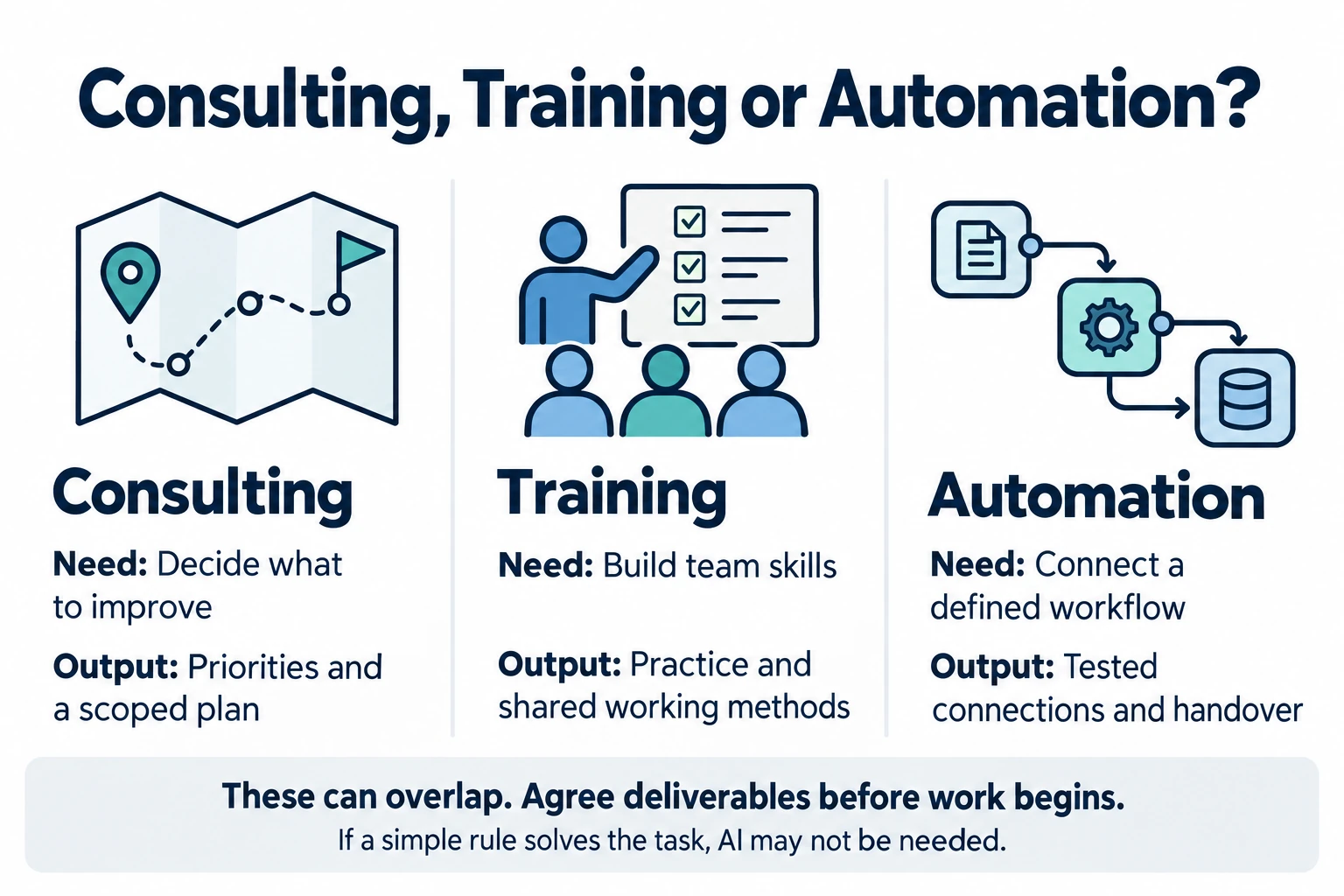
The starting point depends on whether the gap is direction, skills or a defined workflow.
For businesses still identifying their starting point, the Mental Forge AI readiness audit offers questions about workflows, team capacity, and existing tools.
What Happens During an AI Consulting Engagement
An engagement should connect each stage with a clear decision and an agreed output.
What an AI Consultant Checks During Discovery
During discovery, an AI consultant reviews the current workflow, tools, available information, and people involved. A baseline may record handling time, correction rates, or missed follow-ups.
The team should also clarify data access and who will own the process internally. Anonymized examples can help explain the task during early discussions without sharing unnecessary customer information.
How the Scope and Pilot Are Agreed
The written scope should name the task, deliverables, exclusions, responsibilities, and acceptance criteria. It should explain what would justify continuing, revising, or stopping a pilot.
Testing needs to include missing information and unusual requests, alongside routine cases. A polished demonstration alone does not show how a workflow will perform during daily operations.
How Implementation and Handover Are Planned
Implementation may include configuration, integrations, deployment, documentation, and training. Ongoing maintenance may be a separate service.
Before handover, the business should know who checks outputs, handles failures, and updates the workflow. NIST’s voluntary AI Risk Management Framework provides a foundation for considering risks throughout AI use and evaluation.
What Deliverables Should Be Agreed Before Work Begins
The deliverables should make the work understandable and usable. Depending on the scope, these may include:
- A workflow map showing delays, handoffs, and existing systems.
- A prioritized shortlist of suitable use cases.
- A written plan with responsibilities, costs, and exclusions.
- Pilot findings compared with the original baseline.
- Documentation, training, and a support arrangement.
An AI consultant should explain which outputs are included and which require further work. An assessment-only engagement can be useful when its purpose is clear.
Ownership needs the same clarity. Confirm what the business owns or licenses, including configurations, prompts, documentation, and custom code. Establish who controls accounts and what happens when support ends. Underlying software remains subject to its provider’s terms.
How Much Does an AI Consultant Cost
The cost depends on the scope, complexity, and delivery model. An assessment, a working integration, and ongoing support cover different amounts of work, so headline prices alone are difficult to compare.
An AI consultant may charge hourly, quote a fixed fee for defined deliverables, or offer continuing support through a retainer. Each proposal should explain what the price covers.
The full budget may include:
- Consulting and implementation fees.
- Software subscriptions and usage charges.
- Data preparation and integration work.
- Staff training, review time, and maintenance.
More systems, poor data, and complex approval requirements can increase the work involved. A useful quote separates initial costs from recurring expenses and explains how changes will be priced.
When comparing proposals, check that the deliverables and support obligations match. Time recovered by employees can be valuable, but it does not automatically become a reduction in payroll costs.
A Consulting Engagement in Practice
Consider a hypothetical Fort Worth home-services business. Website enquiries arrive by email, details are copied into a customer relationship management system, and replies are drafted manually.
An AI consultant might first assess where requests stall and what information staff need. A pilot could then summarize enquiries and prepare draft replies using approved business information, while ordinary automation updates records.
Staff would review replies before sending them. Missing details and unusual requests would be returned for attention.
Agreed outputs might include a workflow map, a limited pilot, test findings, and handover instructions. Response preparation time, correction rates, and missed follow-ups could help assess value. This is an illustrative example, not a Mental Forge client result.
Questions to Ask Before Hiring an AI Consultant
Before choosing a provider, ask:
- What business problem and measurable outcome are in scope?
- What will be delivered, and what is excluded?
- Who will do the work, and what is needed from our team?
- How will data access, incorrect outputs, and failures be handled?
- What recurring costs and maintenance responsibilities will remain?
- What will we own or license when the engagement ends?
The answers should be specific enough to compare with the written proposal. Vague deliverables or guaranteed savings deserve further questions before a commitment is made.
Frequently Asked Questions
Can a Small Business Start Without Technical Staff
Yes. A business owner can explain the workflow and its problems. Specialist help may still be needed for integrations, access controls, and maintenance.
How Long Does an Engagement Take
Timing depends on scope, data readiness, system access, testing, and staff availability. A proposal should explain milestones and dependencies.
Does Consulting Always Include Implementation
No. Some AI consulting services end with recommendations. Others include building and deploying workflows. The agreement should state which applies.
Discuss Your Workflow With Mental Forge
If you are looking for an AI consultant in Fort Worth or elsewhere in North Texas, start with one recurring task. Note the tools involved, where work gets delayed, and what a useful improvement would look like.
Bring that example to Mental Forge to discuss whether consulting, practical training, or automation fits your next step.