
There's a specific kind of frustration that surfaces in a lot of Texas business conversations right now. You've heard the AI buzz. You've watched competitors start mentioning it in their marketing like it's old news. A few people on your team swear by ChatGPT; others haven't touched it. And somewhere in the background, a question keeps coming up: are we actually ready for this or are we about to waste six months and real money finding out we weren't?
This audit gives you a real answer.
Not which tools to buy. Not which vendor to call. Something more useful. An honest read on whether your business has the foundation to get results from AI right now, or whether jumping in today would cost you more than it delivers.
Why Readiness Comes Before Tools
A Dallas Fed Business Outlook Survey found that Texas businesses using AI jumped from 38% in April 2024 to nearly 60% by mid-2025. That's a significant shift in under eighteen months. But adoption rates don't tell you much on their own; the more important question is what happens after a business starts using AI.
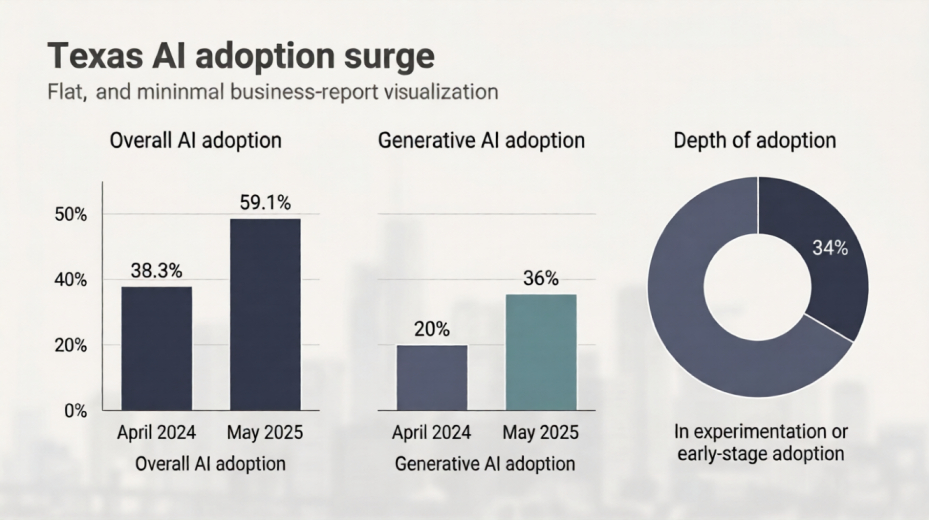
Deloitte's 2026 State of AI in the Enterprise report found that only 34% of organizations are genuinely transforming through AI, while the majority stay stuck in early experimentation. The AI skills gap, not the technology itself, was cited as the number one barrier. And the U.S. Chamber of Commerce found that while 58% of small businesses used generative AI in 2025, most were still testing tools without a broader strategy for making them work.
The gap between businesses using AI and businesses benefiting from it comes down almost entirely to readiness. Tools don't fix readiness gaps. They expose them.
What This Audit Actually Measures
This isn't a random checklist. The ten questions below cover four specific dimensions that consistently determine whether AI adoption delivers results or dies in a browser tab: your team's bandwidth and openness, the clarity of your pain points and use cases, your leadership culture, and your existing tool foundation. Getting honest answers across all four gives you a real picture of where you stand.
How to score: Each question has three options. Select the one that most honestly describes your business today.
- Option A = 0 points
- Option B = 0.5 points
- Option C = 1 point
The 10-Question AI Readiness Audit
Section A: Team & Bandwidth
Q1. How much time does your team spend on repetitive, manual tasks each week?
- A) Honestly, we haven't stopped to measure it — everyone's just keeping up.
- B) I can name a few processes that feel inefficient, but nothing's been documented.
- C) We've identified specific bottlenecks and have a rough sense of how much time they consume.
Q2. If your team had to learn a new productivity tool over the next few weeks, how would they respond?
- A) There'd be resistance. Change is genuinely hard here.
- B) A few people would jump in, but getting everyone aligned would take real effort.
- C) Most people would try it, particularly if they understood the reason.
Q3. Do you have at least one person — even part-time — who could champion a new process or tool and see it through?
- A) Not really. Everyone's bandwidth is stretched thin.
- B) There's someone who could, but it's not their defined role.
- C) Yes. We have someone who drives adoption and follows through.
Section B: Pain Points & Use Case Clarity
Q4. Can you name one specific business problem that consistently costs you time or money — right now?
- A) There are so many, it's hard to isolate just one.
- B) I have a general sense, but haven't defined it clearly enough to act on it.
- C) Yes — one specific process I'd fix tomorrow if I could.
Q5. How well do you understand what AI can and can't realistically do for a business like yours?
- A) Honestly, not much beyond the surface-level things I've seen on LinkedIn.
- B) I've done some reading, but I still have real questions about what's practical.
- C) Solid enough to have a useful conversation about what makes sense for my operation.
Q6. Have you ever mapped out a business workflow step by step — start to finish — to find where the friction lives?
- A) No. We mostly handle things as they come up.
- B) Informally, but not in a way we could hand to someone else and have them follow.
- C) Yes. We've documented at least one core process end-to-end.
Section C: Leadership Culture & Training Openness
Q7. How does your leadership team currently talk about AI?
- A) It barely comes up — there are more pressing things to handle.
- B) We discuss it occasionally but haven't committed to any real direction.
- C) We've agreed AI is worth investing in and are working out where to start.
Q8. If your team needed structured training to use new AI tools effectively, would that be supported?
- A) Training time is hard to justify right now, everyone's already stretched.
- B) We could probably carve out time, but it would need to prove its value fast.
- C) Yes. We understand that training is what turns tools into results.
Q9. When leadership introduces something new, how does your team typically respond?
- A) Skepticism first, reluctant adoption later — if it sticks at all.
- B) Mixed. A few people jump in; others need convincing.
- C) Mostly constructive. People try things when they understand the reasoning.
Section D: Your Current Tool Ecosystem
Q10. How would you describe the technology your business currently runs on?
- A) Mostly manual — spreadsheets, email, maybe a basic CRM.
- B) We use several digital tools, but they don't connect well with each other.
- C) We have connected systems and a solid digital foundation, even if it's not perfect.
Tally Your Score
Add up your selected values (0, 0.5, or 1 per question). Maximum score: 10 points.
What Your Score Means
Tier 1 — 0 to 3: Foundation First
Your business is not behind. It's at the starting point that most North Texas companies were at eighteen months ago. What the score tells you is that jumping into AI tools right now would likely generate friction before it generates results.
The highest-value move at this stage isn't finding an AI tool. It's documenting one core workflow, naming your single biggest time drain, and having an honest internal conversation about how your team handles change. Getting that foundation solid before you invest is not a delay — it's the work that makes everything after it actually pay off.
When you're ready to build that foundation with structure and expert guidance, an AI integration consulting conversation is exactly where to start.
Tier 2 — 4 to 7: Ready to Launch
You've got the raw ingredients: some internal alignment, a few pain points you can name, a team that can move when given the right structure. This is actually a powerful position — clear enough to pick a focused first use case and prove the value before you expand.
That first use case matters more than most people realize. The Texas businesses building the most durable AI capability right now aren't the ones who launched the biggest strategy. They're the ones who picked one specific problem, solved it well, and let that early win change how the whole organization thinks about AI.
A structured program like Fusion Foundation was built exactly for this moment, practical, hands-on, and focused on skills your team can use the very next day.
Tier 3 — 8 to 10: Accelerate Now
Your business has the alignment, the operational clarity, and the foundational infrastructure to move from isolated experiments into a real, compounding AI system. The question at your stage isn't whether to adopt AI — it's how to build something that actually scales instead of just accumulating tools.
That shift means integrating your workflows: connecting your communications, your content, your operations, and your team's output into a system that produces consistent results. Businesses at this level benefit most from custom AI integration work designed around their specific operation, not a generic playbook.
For a practical look at how companies in your position build that foundation with discipline, A Clear Path for Small Businesses Starting AI Integration walks through the full process.
Your Score Is a Starting Point — A Conversation Makes It a Plan
Whether you scored a 2 or a 9, a number on a self-assessment can only take you so far. What it can't measure is the specific nuance of your industry, your team's actual working style, or the workflows in your operation that would generate the clearest early results.
That's what a free AI readiness consultation with the Mental Forge team is for. In thirty minutes, you get specific, practical recommendations matched to where your business actually stands, not a generic framework, not a product pitch. Just a real conversation about what makes sense for your operation.
→ [Book Your Free AI Readiness Consultation]
Sessions are available for Texas businesses at every stage of readiness from just getting started to ready to scale.
One Thing This Audit Can't Tell You
A self-assessment captures the measurable dimensions, bandwidth, clarity, culture, and tools. What it doesn't capture is the nuance that only surfaces in a real conversation: the competitive pressures specific to your market right now, the process that would benefit most from automation in your type of operation, or the internal dynamics that a score can't quantify.
The most useful thing you can take from this audit isn't your tier. It's the clarity to walk into a conversation knowing which questions actually matter for your business, and being ready to answer them honestly.
That's when the real work begins.
Want to understand how Texas businesses are putting AI to work in their daily operations right now? Read " Your 90-Day AI Strategy: A Practical Guide for North Texas Business Leaders, a ground-level look at what structured AI adoption actually looks like from the inside.
FAQS
Q: How do I know if my Texas business is ready for AI?
A: The fastest way to assess your readiness is to evaluate four key dimensions: your team's bandwidth and openness to change, how clearly you've defined your pain points, your leadership culture around training and new tools, and the strength of your existing technology foundation. A structured AI readiness audit — like the 10-question assessment in this article — covers all four and gives you a scored result with specific next steps.
Q: What score on an AI readiness assessment means a business is ready to start?
A: A score of 4 to 7 out of 10 typically indicates a business is ready to begin AI adoption in a focused, strategic way. This range suggests enough internal clarity and team openness to choose a specific use case, build a pilot, and prove results before expanding further.
Q: What stops small businesses in Texas from successfully using AI?
A: The most common barriers are not technical — they're organizational. The AI skills gap, lack of a defined strategy, and insufficient change management are the three factors that most often cause AI initiatives to fail before they deliver value. Starting with a readiness assessment and a structured training program addresses all three.
Q: What is the first step for a Texas small business that wants to start using AI?
A: Before selecting any AI tool, the first step is identifying a single, specific business process that is costing time or money — and documenting it. Once that process is clearly defined, businesses can evaluate which AI approaches are most likely to improve it, rather than adopting tools without a clear use case.
Q: Does my business need technical expertise to start with AI?
A: No. The most effective AI adoption for small businesses starts with operational clarity, not technical skills. Understanding your own workflows, pain points, and team dynamics matters more in the early stages than technical knowledge. Practical AI training programs — like Fusion Foundation — are designed specifically for non-technical business owners and teams.