

Picture two emails sitting in a customer's inbox, both from the same company, sent a week apart. One sounds confident, conversational, and unmistakably human. The other reads like it was drafted by a committee that had never met the brand. Both were produced using the same AI tool. The difference was not the technology. It was whether the business had built a system to govern how that tool communicates on its behalf.
That gap, between fast AI output and consistent brand communication, is one of the most underestimated operational challenges facing content teams today. Scaling AI content production is straightforward. Scaling it while preserving everything that makes your brand recognisable to your audience is a different problem, and it requires deliberate infrastructure rather than good intentions.
What AI Content Scale Actually Does to Brand Identity
When businesses begin producing content at volume with AI tools, three patterns tend to appear within the first few months.
The first is tone drift. Without specific guidance embedded in prompts and workflows, AI tools default to a generalised professional register. It is technically correct. It sounds like your industry. But it does not sound like your company, and customers who have read your previous content will sense the shift even if they cannot name it.
The second is channel fragmentation. Social copy, blog posts, customer service replies, and email campaigns each get handled by different team members using different prompts. The result is a brand that speaks with four distinct personalities across four channels simultaneously, which steadily erodes the consistency that builds audience trust.
The third is editorial collapse. Volume increases faster than review capacity, so the quality check that catches voice problems before publication gets shortened or skipped entirely. Once that happens, inconsistency compounds with each content cycle.
None of this is caused by AI being unsuitable for content work. It is caused by deploying AI at speed before defining what consistent, on-brand output actually looks like.
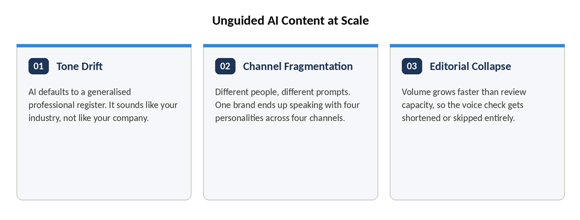
Figure 1: The Three Failure Modes of Unguided AI Content at Scale
What "On-Brand AI Content" Actually Means
Clarity on this point matters before anything else, because businesses often measure the wrong thing.
On-brand AI content is not content that sounds human-written. That framing distracts from the real goal. On-brand AI content is content that sounds like your specific business, reflecting your values, your relationship with your audience, and the distinct personality your brand has developed over time. Whether a human or an AI tool produced it is irrelevant to your customer.
This means on-brand quality has three measurable dimensions. The content sounds like you, meaning tone and vocabulary match your established voice. It communicates the right things, meaning messaging reflects your positioning and priorities. And it fits the channel, meaning register adapts appropriately without abandoning the underlying personality.
When all three are present, AI-assisted content becomes indistinguishable from your best human-written work. When any one is absent, customers sense the inconsistency even if they cannot pinpoint where it comes from.
Why Most AI Content Processes Break Down
The most common failure points are specific and avoidable once you know what to look for.
Starting without a documented voice standard. A brand guide filed in a shared drive that nobody references is not a working system. Voice standards need to live inside the tools and workflows your team uses daily, translated into prompt language that AI tools can act on consistently.
Writing prompts from scratch each time. Generic prompts produce generic content. When every team member improvises a prompt for each content task, output quality becomes entirely dependent on that individual's understanding of the brand, which varies significantly from person to person and day to day.
Treating all content as carrying the same risk. A product FAQ and a response to a customer complaint demand entirely different levels of human involvement. Without a framework that distinguishes between them, teams either over-automate high-stakes content or fail to use AI fully on lower-risk tasks.
Skipping the voice review layer. Grammar checks and factual accuracy reviews are not voice reviews. Catching tone drift before publication requires a separate, deliberate editorial pass with a clear standard to measure against, not a combined skim for surface errors.
Building Brand Voice Architecture Before You Scale
The most effective approach to on brand AI content at scale begins before a single prompt is written. It begins with what practitioners call Brand Voice Architecture: a structured, operational system that defines how your brand communicates and translates that definition into every workflow your content team runs.
Mental Forge's Brand Voice Architecture (BVA) service is built precisely around this challenge. The engagement starts with audience mapping and competitive voice differentiation, not generic adjective lists, but a specific understanding of what makes your communication meaningfully distinct from every competitor in the same conversation.
From that foundation, the BVA process builds tone frameworks, vocabulary standards, and AI-ready content guidelines your entire team can apply consistently. Every content type gets its own calibrated guidance. Blogs sound like your brand. Emails sound like your brand. Customer service responses sound like your brand. The personality stays constant while the register adapts appropriately to each channel.
A well-built voice architecture answers questions generic brand guides typically ignore. How does your brand handle technical complexity: do you explain it or simplify it? What emotional register belongs in customer-facing communications versus thought leadership? Which phrases has your brand avoided historically, and why? How should tone shift when addressing a frustrated customer versus a prospective one?
Teams that build this foundation before scaling consistently report two improvements: AI prompts produce better first drafts because the guidance is specific and actionable, and editorial review moves faster because reviewers have a clear standard rather than relying on subjective instinct.
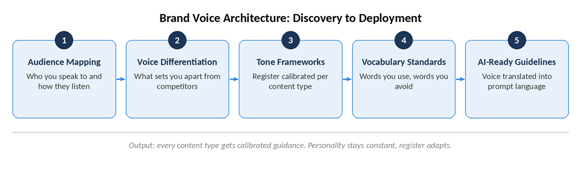
Figure 2: Brand Voice Architecture — From Discovery to Deployment
| Is your current AI content process built on a documented voice standard? If your team writes prompts from scratch for each task and reviews output without a voice checklist, you are producing AI content without brand governance. Mental Forge's Brand Voice Architecture consultation builds the foundation that makes every AI tool your team uses more effective, starting in 30 days. Visit our brand voice architecture services to learn more. |
Classifying Content Risk Before Deploying AI
Not all content should flow through the same AI-assisted process. A practical risk classification framework divides output into two categories, each requiring a different level of human involvement.
Lower-risk content includes product descriptions, blog post outlines, FAQ responses, social media captions, and meta descriptions. These can be substantially AI-generated with brand-embedded prompt templates, requiring human review for voice accuracy but not heavy creative involvement in drafting.
Higher-risk content includes brand positioning statements, responses to customer complaints or sensitive situations, campaign copy that defines public perception of the business, and any communications during service disruptions or crises. These require human-led drafting with AI serving a research or editing role at most.
Building this classification system is the first governance decision every organisation should make when establishing an AI content workflow.
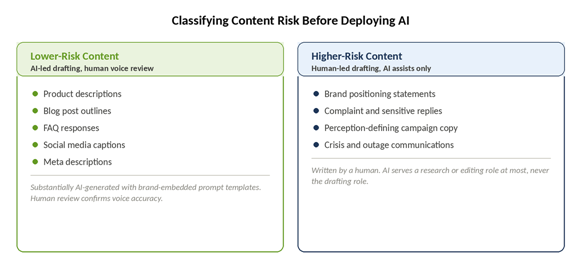
Figure 3: AI Content Risk Classification Matrix
Engineering Prompts That Carry Your Brand
Once a voice architecture exists, the priority is embedding it into a reusable prompt library: a standardised set of AI instructions that your team draws from for recurring content tasks rather than rebuilding from scratch each time.
An effective brand-embedded prompt does several things simultaneously. It specifies the tone register appropriate to the content type. It defines vocabulary level and technical depth appropriate to the audience. And it communicates your brand's structural preferences, whether your style runs direct and punchy or methodical and thorough. It sets the relationship implied by the language, whether you are addressing a peer, a client, or a newcomer. And it includes hard constraints around terminology or framing your brand avoids.
A complete prompt library covers your most frequent content tasks: blog introductions, email subject lines, LinkedIn posts, customer service response frameworks, proposal summaries, and landing page headlines. Each template has voice guidance built in from the start. When a team member needs content, they work from the right template rather than improvising from zero.
The practical effect is significant. When prompts are standardised and brand-embedded, the variable that most affects output quality, which is who wrote the prompt and how well they understand the brand, is removed from the equation. Consistency becomes structural rather than dependent on individual skill or memory.
The Human Editorial Layer: What AI Cannot Do for Itself
AI content tools have no mechanism for detecting their own voice drift. A model can produce confident, well-structured writing that is subtly off-brand in ways the tool itself will never identify, because the tool has no understanding of what your brand sounds like or why it sounds that way.
Human editorial review remains essential in any scaled AI content operation. The key is structuring it to be efficient rather than burdensome.
The most effective approach separates factual review from voice review. These are different cognitive tasks that should not be combined into a single read-through. Factual review is analytical: checking sources, verifying claims, confirming accuracy. Voice review is perceptual: reading for rhythm, register, and whether the writing feels like your brand. Combining them usually means one gets shortchanged.
A voice checklist for editorial reviewers should address three questions for each piece of content. Does this sound like us? Would a regular customer recognise this as coming from our brand? Does the tone match what is appropriate for this channel and this audience relationship? These questions become fast and answerable when there is a documented voice standard to measure against. Without one, they remain slow, subjective, and inconsistently applied.
For workflow structure, a linear review process suits lower-risk content. An iterative flow with a revision cycle suits blog content and email campaigns. A stage-gate flow with multiple approval checkpoints suits brand-defining campaigns and sensitive communications.
Maintaining Consistency Across Every Channel
The most demanding test of a brand voice system is not any individual piece of content. It is consistency across all channels running simultaneously: blogs, email sequences, social posts, customer service replies, sales proposals, and chatbot interactions, each produced by different team members using different tools, all needing to communicate like the same business.
Each channel has distinct format requirements. None should have a distinct brand personality. A customer who reads a confident, direct blog post and then receives a stilted email from the same business does not experience two separate channels. They experience an inconsistency that creates quiet doubt about the brand.
The solution is channel-specific voice calibrations layered on top of a consistent core standard. Your blog may use longer explanatory structures. LinkedIn posts run sharper and more direct. Customer service responses lean warmer and more empathetic. The underlying vocabulary, values, and personality remain constant across all of them.
This is where integrating AI tools directly into your existing content and marketing workflows delivers its most significant return. When voice standards are embedded at the system level, cross-channel consistency stops requiring manual effort with each content cycle and becomes a structural property of how your content operation runs.
Governance, Auditing, and Long-Term Voice Maintenance
Informal review processes stop scaling when content volume increases or team size grows. A two-person team can maintain editorial alignment through conversation. A team of eight producing content across six channels cannot rely on the same approach.
Content governance at scale means defining four things clearly. Who is responsible for voice quality across the organisation? How does content move from AI output to publication with voice accuracy confirmed at each stage? What process handles a piece that fails a voice review? And how does the voice standard itself get updated as the brand evolves?
Regular audits of published AI-assisted content are equally essential. Brand standards shift as businesses grow. New team members bring their own communication instincts. AI tools update their underlying models. Without periodic review of what is actually reaching your audience, drift accumulates quietly until someone notices the brand sounds noticeably different from what it was twelve months ago.
A quarterly audit rhythm for lower-risk content and monthly review for higher-visibility output is practical for most small and midsize businesses. The goal is not perfection in every piece. It is catching systemic drift early enough to correct it before it compounds into a brand perception problem.
Mental Forge's Fusion Foundations workshops equip teams with the practical skills to build and maintain these governance systems, not as abstract AI theory, but as working frameworks applicable from the next business day.
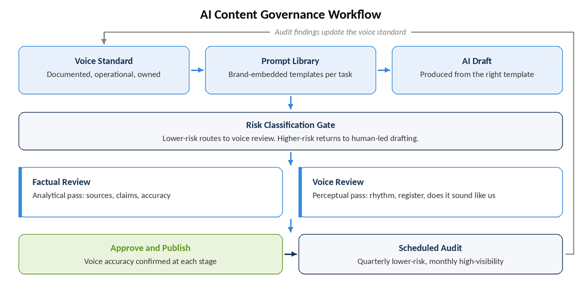
Figure 4: AI Content Governance Workflow
The Compounding Return on Voice Consistency
Brand voice consistency does not deliver a single measurable result. It compounds over time in ways that are difficult to attribute to any individual piece of content but become clearly visible across a twelve-month horizon.
A business that publishes recognisably on-brand content across every channel consistently has built something competitors cannot easily replicate: an audience that recognises the voice before seeing the logo, trusts the communication because it has been reliable, and returns because the brand feels familiar. That recognition and that trust are not produced by any single campaign. They accumulate through consistency.
AI tools make it possible to maintain that consistency at volumes that were not practically achievable several years ago. The constraint is no longer production capacity. It is the structural investment required to ensure AI output reflects an actual brand identity rather than a competent approximation of one.
That investment, in voice architecture, prompt libraries, content risk classification, editorial processes, and governance frameworks, is what separates businesses using AI to compound their brand equity from businesses using AI to produce more content while quietly diluting the identity they spent years developing.
The goal was never to publish more content faster. It was always to communicate more effectively with the audience that matters most. AI content at scale, governed well, makes that possible without compromise.
| Ready to build a scalable AI content system that sounds like your business? Mental Forge's Brand Voice Architecture consultation is designed for business leaders who want to scale AI content production without trading away the brand identity that earns customer trust. Engagements run from a 30-Day Intensive to a full 90-Day Deep Dive, each built around your real voice, your real audience, and your real content workflows. Start the conversation at mentalforge.ai. |