
Most explanations of AI do one of two things. They go so deep into neural architecture and transformer models that you need a computer science degree to follow along. Or they stay so surface-level that you finish reading knowing nothing more useful than when you started.
This is neither of those.
I describe AI as the world's most expensive autocomplete, and most people immediately say "that's it?" with a slightly deflated look. Yes. But what it autocompletes, and why that's remarkable, is where the value actually lives. By the end of this post, you'll understand how AI works, a simple explanation built for business owners, not engineers. No diagrams. No code. Nor any jargon that doesn't earn its place.
This is AI explained for beginners, but built for business. There's a difference, and it matters.
If you've already encountered some of the fear and confusion around AI at work, you're not alone. I've written about the most common AI myths businesses still believe and this post is the natural next step once those myths are out of the way.
AI Doesn't Think — It Predicts (And That Distinction Changes Everything)
This is the foundation. Everything else builds on it.
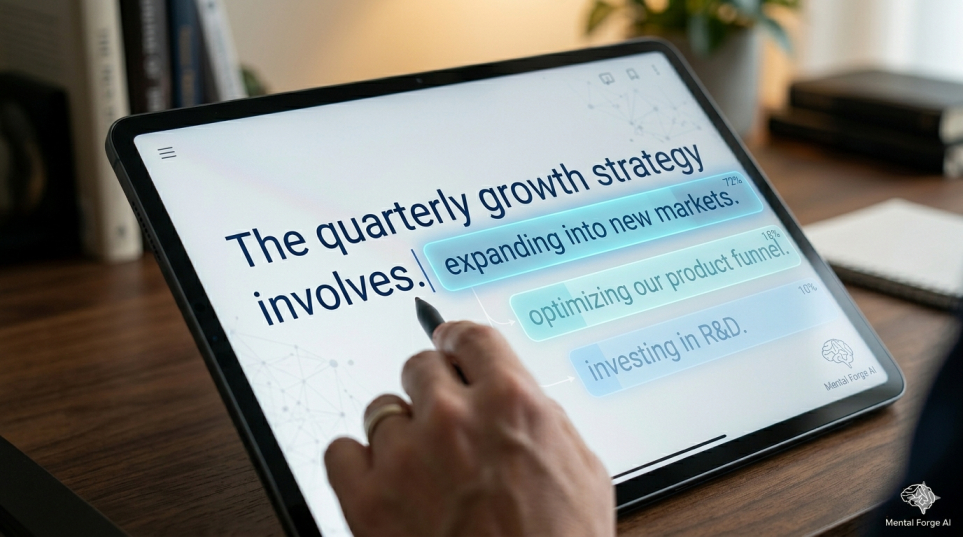
AI does not have opinions. It doesn't have understanding. It doesn't experience curiosity or frustration. On top of that, it has no consciousness, no intuition, and no inner life of any kind. What it has is an extraordinarily refined ability to predict what should come next in a sequence of words, based on patterns it has seen across billions of examples of human-written text.
That's the autocomplete. But at a scale that can write a business proposal, summarize a legal document, draft a week's worth of emails, or explain a complex concept in plain language.
When you know AI is prediction-based, your relationship with it changes immediately. You stop expecting magic and start expecting probability. You stop being surprised when it gets something wrong — because you understand it's making a very educated guess, not accessing some reservoir of cosmic truth. And you start thinking about how to give it better inputs, because better inputs shift the probability toward better outputs.
Probability, when well-directed, produces very useful output.
That one shift in understanding — prediction, not thinking — is worth more than any technical explanation I could give you.
Pattern Completion: The Mechanic Behind the Magic
Here's how the prediction actually works, without going anywhere near the technical details.
Imagine you're reading a sentence and the last word is missing. "She picked up the phone and said ___." Your brain fills that in instantly. You don't consciously calculate it — you've seen enough of how language works that the completion feels automatic. AI does something structurally similar. It looks at what came before and predicts what comes next. The difference is the scale of what it's been trained on.
What Is a Large Language Model?
A Large Language Model, LLM, if you've seen that abbreviation, is a system trained on billions of text samples to recognize language patterns well enough to complete them.
Think of it like finishing someone's sentence, but trained on more reading than any human could accomplish across a thousand lifetimes. Books, articles, websites, documentation, conversations, the model has processed enough human-written language to develop a remarkably detailed map of how words, ideas, and structures relate to each other.
The pattern it completes depends entirely on the pattern you start. That's not a limitation. It's the instruction manual.
The autocomplete knows what comes after context. The more context you provide, the more precisely it can pattern-match toward something genuinely useful. Give it a stronger start, and it completes toward a stronger end.
Where AI's Knowledge Comes From (And Why That Changes How You Use It)
AI doesn't browse the internet in real time when you ask it a question. It draws on what it learned during training, a process where the model was exposed to enormous volumes of human-written text and developed its pattern recognition from that exposure.
This is important for how you think about AI as a business tool.
What AI "knows" is what human-written content looks like. It can reproduce the structure of a well-argued business case, the tone of a professional email, the format of a project brief because it has processed thousands of examples of each. It has developed a sophisticated sense of what good writing looks like across an enormous range of contexts.
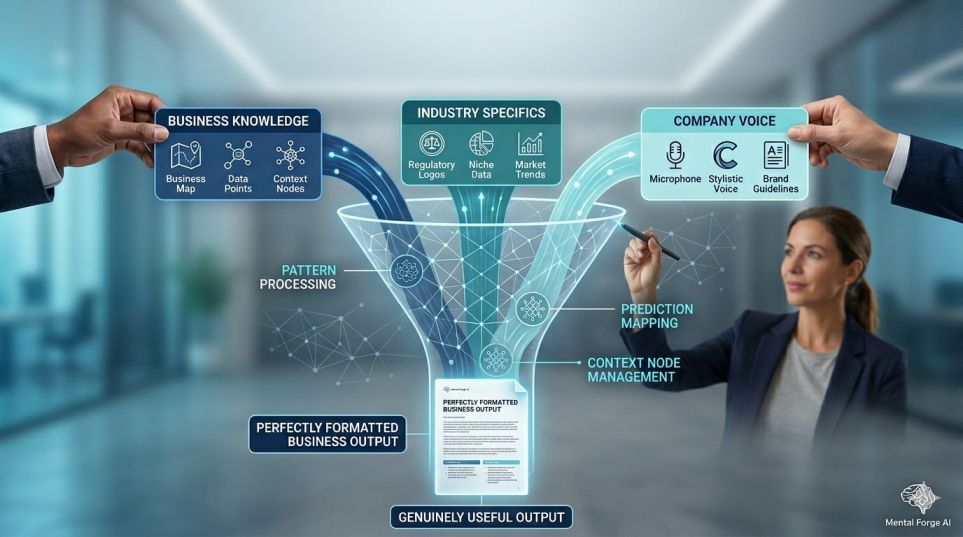
Here's the critical nuance: it knows what's common, not necessarily what's true. It replicates patterns. When those patterns align with accurate information, the output is accurate. When you're asking about something unusual, niche, or highly specific to your business, the pattern it's matching to may not be the right one, because your context isn't in its training data.
The practical implication is straightforward: the more context you provide in your prompt, the less the AI has to rely on generalizations. Your business knowledge, your specific situation, your particular constraints, when those go into the prompt, the output comes out shaped around them rather than around some average version of your industry.
The autocomplete only works with the vocabulary it's been exposed to. Your job is to add the vocabulary it's missing.
The Knowledge Cutoff: Why AI Doesn't Know What Happened Last Week
One of the most practical things to understand about how AI works is the knowledge cutoff.
AI models are trained up to a specific date. After that date, they have no awareness of what has happened in the world. A model with a cutoff in early 2024 doesn't know about things that were published, announced, or discovered after that point unless you tell it.
The business implication is simple: don't use AI for real-time research. Use it for reasoning, drafting, structuring, and pattern-based output. Use it to think through problems, generate options, and produce first drafts. Plus, use other tools, search engines, databases, and your own team's knowledge for current facts.
You wouldn't ask a colleague who has been completely offline for eighteen months to brief you on last week's news. The same logic applies here. Understanding the boundary makes the tool significantly more useful, because you stop asking it to do things it can't do and start directing it toward things it does exceptionally well.
Prompts Are the Control System — And Anyone Can Learn to Use Them Well
A prompt is an instruction. That's the whole definition.
The quality of your instruction determines the quality of the output. This is not a flaw in the technology. It's how every tool works. A hammer doesn't know what you're building. A spreadsheet doesn't know what calculation matters. AI doesn't know what you need until you tell it.
What's often called "prompt engineering" in technical circles is, for business purposes, a communication skill. The same skills you've built over years of managing people, briefing contractors, writing client emails, those are prompt skills. You already have the foundation.
Here's a practical breakdown of what makes a prompt work:
What you're asking for, the task itself, is stated clearly and specifically. Not "write something about our services" but "write a 150-word description of our bookkeeping services for clients who are switching from a DIY approach."
The context you provide is the background that the AI doesn't have. Who is the reader? What do they already know? What outcome are you working toward? And what has already been tried?
The format you want, length, tone, structure, and level of formality. AI will make these choices for you if you don't specify them. Usually, its choices are less useful than yours.
The autocomplete follows your lead. The cleaner the lead, the better the follow.
For more on how business professionals are using this in practice, read how business leaders use prompts to get better AI results. It covers real examples from people using these tools in their day-to-day work.
ChatGPT, Claude, and Gemini — What's the Difference? (And Which One Should You Use?)
You've probably heard all three names. Here's what actually matters for a business user.
ChatGPT (OpenAI) — The Most Recognizable
ChatGPT is the most widely used AI tool in the world right now, and that ubiquity matters. It has the largest ecosystem of integrations, the most third-party plugins, and the most existing documentation, tutorials, and community support. For most business users starting out, it's the most practical first tool because when you get stuck, help is easy to find.
It handles a wide range of tasks well: drafting, summarizing, brainstorming, coding help, analysis, customer communication templates.
Claude (Anthropic) — The Nuanced Communicator
Claude tends to perform particularly well with longer documents and more nuanced writing tasks. It's strong at following detailed, multi-part instructions, which makes it a good fit for professionals who need AI to hold a lot of context at once. If your work involves lengthy reports, detailed briefs, or complex structured documents, Claude is worth testing alongside ChatGPT.
Gemini (Google) — The Search-Connected Option
Gemini is Google's AI, which means it's built to integrate with the Google Workspace tools many businesses already use: Gmail, Docs, Sheets, and Drive. If your team lives in Google's ecosystem, Gemini has native connectors that the other tools don't offer in the same way. That integration reduces friction, which is often more valuable than raw capability.
All three are autocomplete engines at their core. The interface differs. The training data differs. The integration options differ. The underlying logic does not.
Start with one. Learn it well. Then expand if you find a specific gap in what it does.
If you want help deciding which tools fit your business and how to set them up in a way that actually gets used, that's exactly what AI integration consulting for your business covers.
What This Means for Your Business (The Part That Actually Matters)
Understanding AI conceptually is useful. Knowing what to do with that understanding is what creates results.
Three things shift when you genuinely understand how AI works:
First, you stop trusting it blindly and start managing it intelligently. You know it's making predictions, not accessing truth, so you verify what needs verifying and use your own judgment where the stakes are high. That's not skepticism. That's good management.
Second, your advantage isn't the tool. But it's what you bring to it. Your industry knowledge, your client relationships, your understanding of what your specific customers need, none of that is in the training data. When you feed that context into AI, the output becomes something no generic user can replicate, because the inputs were yours.
Third, the speed of implementation matters more than people think. Every week of inaction is a week of compounding disadvantage, not a catastrophic one, but a real one. The teams building fluency with these tools right now are developing habits, confidence, and institutional knowledge that takes time to build. Starting later means starting further back.
Your expertise, judgment, and industry knowledge are what make AI output useful for your business. The tool doesn't have those things. You do. That combination, your knowledge directing AI's capability, is what produces genuinely useful output.
If you want to build that fluency in a structured setting with real business tasks, hands-on AI training for business teams is exactly what the Fusion Foundation workshop is designed to deliver.
You Don't Need Deeper Technical Knowledge — You Need to Start Using It
The world's most expensive autocomplete is also the most available tool in business history. It's in your browser right now. It has a free tier. It doesn't require installation, training data, or a single line of code to begin using.
Understanding it doesn't require engineering knowledge. Using it well requires communication skill — and you've been building that for your entire career. The technical details — the architecture, the model weights, the infrastructure — those will sort themselves out as the tools evolve. They're not your job to understand.
Your job is to know what you want, be able to describe it clearly, and recognize when the output needs refinement. That's a skill you already have the foundation for.
This is AI explained for the way business people actually think, not as a technical puzzle to solve, but as a capable tool to direct. The first step isn't a course, a certification, or a technical deep-dive. It's using it for something real, this week, and seeing what happens.
Take the Next Step in a Room Built for It
The Fusion Foundation workshop takes exactly what you just read and puts it into practice.
In a focused session, you'll go from understanding AI in theory to using it in your actual workflow, with your real tasks, your real challenges, and real-time feedback on what's working. Not a lecture. A working session.
Sessions are capped at 30 participants. The environment is intentionally small so that the learning is practical, not passive. Our next session in North Texas fills faster than most people expect.
Reserve your seat at our next AI workshop in North Texas →