The average roofing lead in North Texas has a short window. After a hailstorm, a homeowner calls three companies. Whoever shows up first, follows up fastest, and sends an estimate within 24 hours typically wins the job. The company that calls back two days later, or sends a follow-up email a week after that, rarely makes it to the inspection.
Most roofing companies in the DFW market are not losing jobs because of pricing or workmanship. They are losing jobs because their CRM and follow-up process is manual, inconsistent, and built for a slower-moving sales cycle than the storm-season reality demands.
This article covers how CRM automation for roofing companies addresses this directly, specifically what was implemented for a North Texas roofing contractor, what the 30-day results looked like, and how the sales pipeline automation system was structured from lead capture through estimate delivery.
The Roofing Sales Problem That CRM Automation Solves
Roofing is a volume-sensitive, timing-sensitive business. During active weather seasons in North Texas, a midsize contractor can receive 30 to 50 inbound leads in a 72-hour window following a significant storm. No sales team manages that manually with consistency.
What actually happens: the first 10 leads get called back the same day. The next 15 get called back the following morning. The final 10 get reached on day three, at which point half of them have already signed with another company. The estimator's calendar fills up before the follow-up is complete, and the jobs that slipped through the cracks are invisible because nothing was tracking them.
The National Roofing Contractors Association has consistently documented that roofing contractors face one of the most compressed sales cycles in the residential trades. Speed-to-contact is the primary differentiator in insurance claim work, not relationship history.
Roofing CRM automation does not replace your sales team. It makes the system underneath them function at the speed and consistency the market requires — automatically capturing leads from every source, triggering immediate follow-up, scheduling estimates, and moving opportunities through the pipeline without anyone manually deciding what happens next.
Why Roofing Sales Processes Break Down Without Automation
Manual CRM management in a roofing company typically means one of two things: a spreadsheet that the owner updates when they remember, or a CRM that was implemented once and never fully adopted. Either way, the outcome is the same. Leads fall through. Follow-up sequences are inconsistent. No one knows which estimates are outstanding without asking someone directly.
The structural problem is that roofing sales involves multiple handoffs: lead capture to initial contact, initial contact to inspection scheduling, inspection to estimate delivery, estimate to signed contract, signed contract to material order, and crew scheduling. Each handoff is a point where something can stall, and in most roofing companies, each handoff is entirely manual.
Research from Salesforce's State of Sales report found that sales reps at high-performing companies spend nearly 70% of their time selling. In contrast, underperforming teams spend the majority of their time on administrative tasks. In roofing, the administrative overhead — updating statuses, sending follow-up emails, tracking outstanding estimates — competes directly with time in the field running inspections and closing jobs.
Roofing workflow automation eliminates the administrative overhead by handling it automatically. The sales team focuses on inspections, relationships, and closings. The system handles the rest.
What CRM Automation for a North Texas Roofing Contractor Actually Looked Like
A residential roofing and restoration company in the DFW metro engaged Mental Forge for a CRM automation build designed around the challenges described above. The company was running 8 to 12 active estimates at any given time, missing follow-ups on roughly 30% of outstanding leads, and spending three to four hours per day on administrative pipeline management across the sales team.
Phase 1: Lead Capture Unification
The first step was connecting every lead source — paid social ads, Google Local Services Ads, organic website form submissions, and inbound calls — into a single CRM pipeline. Previously, leads from different sources landed in different places: some in a spreadsheet, some in email inboxes, some never captured at all.
The unified lead capture system pulled every inbound inquiry into one CRM view with automatic source tagging. The sales team saw all leads in one place for the first time, with zero manual entry required. Every lead that entered the system triggered the next step automatically.
Phase 2: Automated Follow-Up Sequences
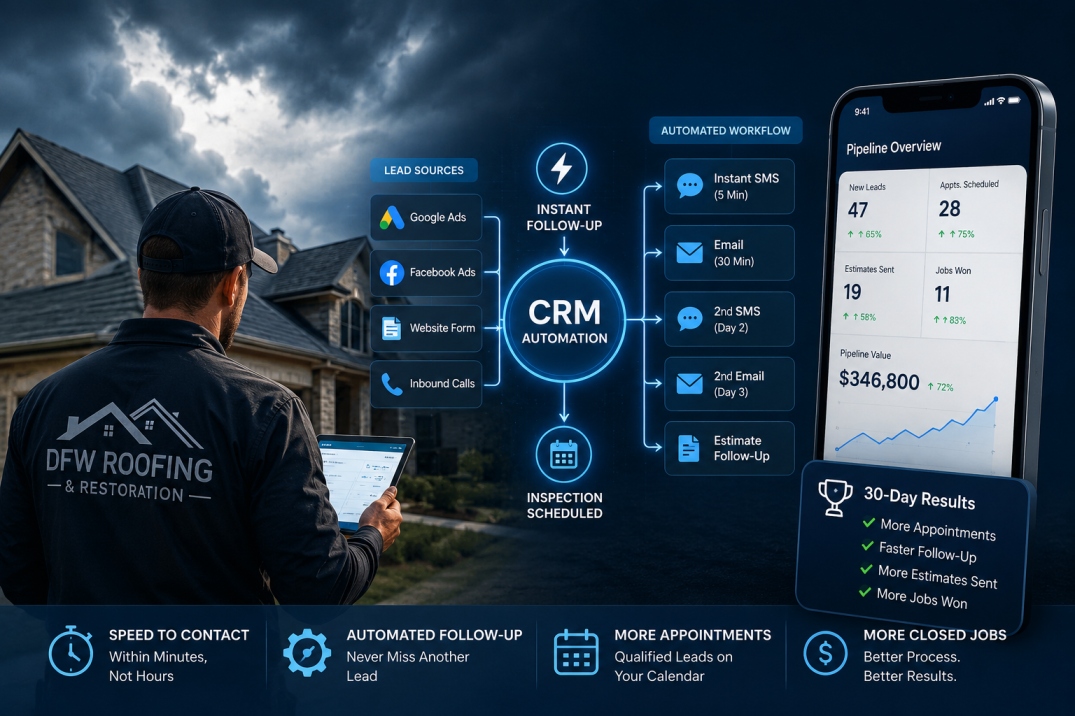
The second component was a multi-touch follow-up sequence that launched the moment a lead was captured. The sequence ran as follows: an SMS within five minutes of lead submission acknowledging receipt and providing an estimated callback window. An email within 30 minutes with company information and a direct link to schedule an inspection. A second SMS on day two if no response. A second email on day three with a specific offer tied to current storm damage documentation requirements.
This sequence ran automatically. The sales team received a notification if a lead responded or clicked, allowing them to pick up the conversation at the right moment. Leads that did not respond within seven days were tagged for a re-engagement sequence rather than disappearing into the pipeline with no status.
Phase 3: Estimate Follow-Up Automation
Estimate follow-up was the highest-priority automation for this company. Outstanding estimates that had not received a response within 48 hours triggered a personalized follow-up message referencing the specific address and job type. A second follow-up ran at 96 hours. A third at seven days, which offered to schedule a follow-up call if the homeowner had questions about the estimate.
This single automation recovered multiple lost jobs in the first month. Homeowners who had received estimates and simply not responded, not because they were uninterested, but because life intervened, replied to the automated follow-up and moved forward. These were jobs the company would have written off under the previous system.
Phase 4: Pipeline Visibility and Reporting
The final component was a daily pipeline summary delivered to the business owner each morning: number of active leads, outstanding estimates by age, jobs currently scheduled, and revenue in the pipeline by stage. This replaced the morning ritual of asking the sales team for a status update and never getting a complete picture.
30-Day Results
The outcomes documented in the first 30 days of the automation system were consistent with what properly built roofing sales automation typically produces when the underlying lead volume is present.
- Lead response time dropped from an average of four to six hours to under ten minutes for all leads regardless of time of day, including leads captured after hours and on weekends
- Outstanding estimate follow-up coverage increased from approximately 40% to 100% — every estimate received at minimum three touchpoints before being marked inactive
- The sales team's administrative time dropped significantly, with estimators reporting they spent the recovered hours on additional inspections rather than pipeline management
- The business owner had daily pipeline visibility for the first time, enabling faster decisions about crew scheduling, material orders, and capacity allocation
It is important to state clearly: these results depend on having real lead volume flowing into the system. Automation accelerates and organizes what exists; it does not generate leads from nothing. The roofing company in this example had active paid campaigns and an established service area. The automation made their existing lead flow convert at a measurably higher rate.
The Technology Stack
The system was built using a combination of CRM platform (Go High Level), automation workflows connecting lead sources via webhook, SMS and email delivery through integrated messaging infrastructure, and a daily reporting pipeline pulling data from the CRM into a structured summary. The build was completed in approximately two weeks, with one additional week of testing before full deployment.
Mental Forge's AI automation services handle the complete build, test, and handoff process, including documentation, so the roofing company's team can manage the system confidently after the engagement closes.
Implementation Recommendations for Roofing Contractors
Start With Lead Capture Unification
If leads are coming in through multiple channels and landing in multiple places, no follow-up sequence will cover them all consistently. Unifying capture is the foundation. Everything else is built on top of it.
Build Follow-Up Sequences Before Lead Volume Spikes
The worst time to build a follow-up automation is during storm season, when the leads are already arriving faster than the team can manage them. Build the system during a slower period, early spring or fall in North Texas, so it is tested and running before peak demand.
Keep the Sales Team in the Loop, Not in the System
The most effective roofing CRM automation setups notify the sales team at critical moments — a lead responds, an estimate is viewed, a follow-up receives a reply, without requiring them to manage the sequence manually. They pick up where the automation creates an opening. This is the difference between automation that complements human judgment and automation that creates confusion.
Measure the Right Metrics
Track lead-to-inspection rate, inspection-to-estimate rate, estimate-to-close rate, and average time-to-response by lead source. These four metrics tell you where your pipeline is strong and where it is leaking. Automation cannot fix every leak, but it makes the leaks visible, which is the first step toward addressing them.
ROI and Business Impact
The business case for roofing lead management system automation is direct. If your company currently converts 25% of leads to inspections and automation brings that rate to 35% — a conservative estimate for a company with existing follow-up gaps — the additional revenue on a $2M annual revenue operation is significant without adding a single new lead source or sales hire.
For contractors running insurance restoration work, the impact is amplified. Insurance claim timelines create natural urgency on the homeowner side. The estimate follow-up automation captures homeowners who are actively motivated to move forward but have not yet received a consistent touchpoint from a specific contractor.
The operational efficiency gains compound over a full season. Estimators running two additional inspections per week because they recovered administrative hours add meaningful capacity without additional overhead. Sales leads that previously aged out of the pipeline are systematically re-engaged rather than silently written off.
Is CRM Automation the Right Next Step for Your Roofing Company?
If your company is running active lead generation, has estimators in the field, and is losing jobs to faster competitors or incomplete follow-up, CRM automation is the highest-leverage operational investment available to you right now. The technology works. The implementation timeline is shorter than most contractors expect. The results are measurable within the first month of the storm season.
The companies that benefit most are those with a defined service area, consistent inbound volume, and a sales team that is spending time on the wrong tasks. Automation moves the administrative burden off your people and onto a system that runs without breaks, vacations, or bad days.
Mental Forge builds CRM and workflow automation systems for North Texas contractors, including roofing, restoration, and home services companies. Our AI automation engagements are built around your actual sales process, not a generic contractor template, and every system is tested before handoff with full documentation your team can follow from day one. For contractors evaluating where to start, our AI integration consulting session maps your current workflow and identifies the highest-impact automation opportunities in your specific pipeline.
Ready to stop losing roofing leads to slower follow-up? Book a consultation with Mental Forge and we will map your current sales process, identify where automation delivers the fastest return, and show you exactly what a working CRM system looks like for a North Texas roofing company.