In 2026, the most successful businesses aren't those with the most AI tools. They are the ones whose tools work together. A law firm with six separate AI tools for intake, drafting, and scheduling spends too much time fixing manual errors. For agencies, contractors, healthcare practices, and professional firms, AI only provides a real advantage if it is a connected system, not just a collection of apps.
This guide explains what an AI tech stack is and why service businesses need one by 2026. It covers the core components to build and provides a realistic roadmap to avoid overspending or overwhelming your team.
What Is an AI Tech Stack?
An AI tech stack is a connected set of AI tools and platforms. It includes the integrations, data flows, and rules that let these tools work as one system. It replaces the old model of static software—like a basic CRM, email client, and spreadsheet. In a dynamic stack, AI actively processes data, makes decisions, and moves work between systems.
This distinction is vital for service businesses. SaaS companies build AI into their products from the start. However, service businesses—like clinics or marketing agencies—add AI to existing operations. They must work around real limits: old data, non-technical staff, the need for a human touch with clients, and tight budgets. This requires a specific strategy that actually works in 2026.
Why Service-Based Businesses Need an AI Tech Stack in 2026
Research on Small business technology adoption shows that AI use among U.S. small businesses grew from about one-third in 2023 to nearly 90% by early 2026. AI is now a standard part of operations for most small and mid-size businesses. Service businesses adopt AI quickly because their profits depend directly on labor hours.
A connected AI tech stack improves five key areas:
- Operational efficiency: Fewer manual steps between scheduling, invoicing, and delivery.
- Customer experience: Faster responses and consistent follow-ups without hiring more staff.
- Internal productivity: Less time on emails and reports, and more time on billable work.
- Competitive advantage: Reliable automation allows you to quote and respond faster and scale without increasing overhead.
- Scalability: An integrated stack handles more clients and staff better than manual processes.
Most businesses are still beginners. SMB surveys show that fewer than one in ten businesses have advanced AI adoption. Most only test a few tools without a plan. A deliberate AI tech stack helps you beat competitors who are still just experimenting.
Core Components of an AI Tech Stack
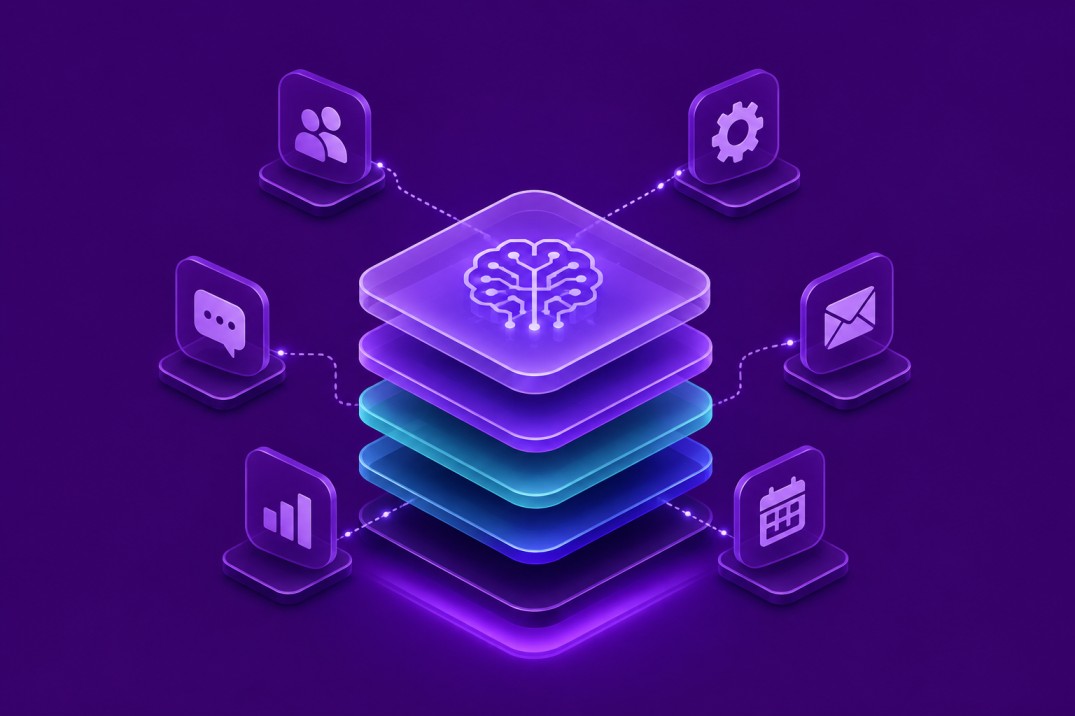
Think of the stack in four layers: client-facing systems, internal operations, content and communication, and the intelligence layer layer that ties everything together.
Client-Facing Systems: CRM, Scheduling, and Customer Support Automation
The CRM is the backbone of the stack for most service businesses, and in 2026 that means an AI-enabled CRM that can score leads, draft follow-up messages, and trigger next steps automatically rather than sitting as a static database. Paired with AI scheduling, which reduces no-shows and removes back-and-forth emails, and AI-assisted customer support, chat and email triage that routes or resolves routine questions, this layer directly reduces the response-time gap between your business and the client's decision window. The common integration pattern connects the CRM to your scheduling tool and your support inbox so a new lead, a booked appointment, and a support ticket are all visible in one place, not three.
Internal Operations: Workflow Automation, Document Processing, and AI Assistants
Workflow automation platforms, connecting apps so an action in one system triggers a task in another, are what turn a stack from a set of tools into a system. Document processing AI handles contracts, intake forms, and invoices without manual data entry. AI assistants, used well, function less as chatbots and more as a layer that drafts, summarizes, and prepares work for a human to review and approve. The best practice here is starting with the highest-friction manual task first, usually intake, invoicing, or reporting, rather than automating everything at once.
Content and Communication: Email Automation, Meeting Intelligence, and Proposal Generation
Service businesses lose enormous time to written communication. Email automation drafts and personalizes routine responses. Meeting intelligence tools convert calls and meetings directly into action items and follow-up notes, removing the 30 to 45 minutes most people spend on post-meeting admin. Proposal generation, when built around a documented process rather than a blank prompt, turns a task that used to take days into one that takes an hour without sacrificing quality. Marketing automation extends the same logic to campaigns, scheduling, and content calendars.
The Intelligence Layer: Analytics, Reporting, Knowledge Management, and AI Search
This layer is where most service businesses underinvest. Analytics and reporting tools that pull data automatically from your CRM and operations systems give owners a real-time view instead of a monthly spreadsheet reconciliation. Knowledge management systems, a searchable internal library of processes, past proposals, and client history, paired with AI search and retrieval, let staff find answers in seconds instead of interrupting a manager. Together, these tools are what let a stack compound in value over time rather than staying static.
How to Build Your AI Tech Stack
Building a stack is a sequencing problem more than a shopping problem. A practical roadmap looks like this:
- Audit current workflows. Map how a lead becomes a client, and how a client becomes a completed job or engagement, before adding any tool. You cannot automate a process you have not documented.
- Identify the real bottlenecks. Look for the steps that consume the most staff hours or cause the most client friction. These are usually intake, scheduling, follow-up, and reporting.
- Select tools that solve those specific bottlenecks. Resist the instinct to buy a tool for every function at once. Start with the two or three highest-impact gaps.
- Connect the systems. A tool that does not talk to your CRM or your calendar creates a new manual task rather than removing one. Working through this stage with an AI integration partner rather than piecing it together alone is usually where the difference between a working stack and a shelf of unused software gets decided.
- Train your team. Adoption fails more often from lack of training than from bad tool selection. Staff need documented workflows and hands-on practice, not a link to a login page.
- Measure ROI. Track time saved, response-time improvement, and error reduction against the cost of each tool. Cut what is not earning its place.
- Scale deliberately. Once the first two or three integrations are stable and adopted, extend the same approach to the next bottleneck.
If your business is at the point where the roadmap above raises more questions than it answers, that is the normal stage to bring in outside help rather than a sign you are behind. Book a consultation to walk through your current workflows against this framework. It is a faster path to clarity than testing tools one at a time.
Common Mistakes Businesses Make
The businesses that struggle with AI adoption tend to make the same handful of mistakes:
- Buying too many tools at once. A stack of five disconnected point solutions is often worse than two well-integrated ones, because it multiplies the logins, exports, and manual reconciliations staff have to manage.
- Ignoring integration. A tool that lives outside your CRM or calendar rarely gets used past the first month.
- No governance. Without a clear policy on what data AI tools can access and how outputs get reviewed, businesses expose themselves to data quality and compliance risk.
- Poor data quality. AI systems amplify whatever is already in your CRM. Duplicate records and outdated fields produce unreliable automation.
- Lack of employee adoption. A tool the team was not trained on or does not trust will quietly stop being used within weeks.
- Chasing trends instead of solving problems. The newest AI agent release is rarely the answer to a bottleneck that a simpler integration would fix.
Future Trends for AI Tech Stacks Beyond 2026
A few developments are worth planning around, even if they are not yet mainstream for most service businesses:
- AI agents and multi-agent workflows. Rather than a single assistant handling one task, connected agents are beginning to hand work off to each other, an intake agent passing a qualified lead to a scheduling agent, for example, with a human reviewing at key checkpoints.
- Predictive automation. Systems that flag likely bottlenecks, a project at risk of missing a deadline, a client likely to churn, before a human notices the pattern.
- Vertical AI solutions. Tools built specifically for a service niche, legal intake, home services dispatch, healthcare scheduling, rather than generic horizontal software, offering better fit with less customization.
- Unified business intelligence. A single reporting layer that pulls from every system in the stack instead of separate dashboards per tool.
None of this requires a business to overhaul its stack today. It is a reason to build the current stack on integrations and data practices that will still make sense as these capabilities mature, rather than on isolated tools that will need to be replaced.
Putting All Togather
A modern AI tech stack is not a list of software subscriptions. It is a connected system built around your actual bottlenecks, sequenced deliberately, and adopted by a trained team. Service businesses that treat AI as a strategy question, not a shopping list, are the ones building a lasting operational advantage in 2026, while competitors still testing individual tools stay stuck in the experimentation phase.
If you are weighing where your business's tech stack has the most room to improve, an outside perspective on your workflows is usually the fastest way to find it. Mental Forge's AI integration consulting is built around exactly this kind of assessment, mapping your current systems and identifying the highest-leverage places to connect AI before recommending a single tool. For businesses ready to move past evaluation and into a working system, Mental Forge's AI automation services design, build, and hand off the workflows this guide describes.
Book a consultation to walk through where your stack stands today and what to prioritize next.
<!-- wp:spacer {"height":