You publish a blog post on Monday. Your social media manager posts a caption on Wednesday. A team member sends a client email on Friday. Three pieces of content. Three different tones. Three different messages.
That is the brand voice problem quietly costing small teams credibility, trust, and audience loyalty. The frustrating part is that most teams do not even realize it is happening.
If your content does not sound like one voice, it does not feel like one brand. Customers notice this before they can name it. They lose confidence, scroll past, or choose someone else.
The good news is that AI has made this problem much easier to solve. However, that only works when you build a proper foundation first.
Why Small Teams Sound Inconsistent (And Why That Hurts Growth)
When Three People Write, You Get Three Different Brands
Small teams rarely have one dedicated writer. Instead, the founder writes the newsletter, the marketing lead handles social, and a part-time contractor produces blog posts. Each person brings their own vocabulary, rhythm, and instincts.
The result is a brand that sounds warm and conversational one day, then corporate and distant the next. Customers do not segment this the way you might expect. They experience all of it as one brand. So when the tone shifts, trust slips. They start to wonder who they are actually talking to.
AI Makes It Faster, But Inconsistency Gets Faster Too
When small teams add AI writing tools to this mix without a clear voice system in place, the problem scales. AI is fast. It can produce a week's worth of content in a morning. But without clear voice parameters, it defaults to generic output that sounds like every other brand using the same tool.
This is precisely why having brand voice AI tools alone is not enough. You need architecture behind them.
What Is Brand Voice Architecture, And Why "Guidelines" Are Not Enough
Most brand guides collect dust. They sit in a shared Google Drive folder, get read once during onboarding, and are forgotten by week two. That is not a brand voice system. That is a document.
Brand Voice Is a System, Not a PDF
Brand Voice Architecture (BVA) is the structured, repeatable framework that defines not just what your brand sounds like, but how every team member and AI tool should apply that voice across every content type. MentalForge's brand voice architecture system is built around exactly this principle. Rather than handing teams a static guide, BVA creates a living communication framework that AI tools can be trained to follow.
It breaks your voice into three actionable layers:
Table 1: The 3 Layers of Brand Voice Architecture
| Layer | What It Controls | Example |
| Tone | The emotional temperature of your content | Friendly and direct vs. formal and distant |
| Language Rules | Specific words, phrases, and structures to use or avoid | Say "you" not "one"; avoid corporate jargon |
| Personality | The consistent character behind every piece of content | Confident mentor vs. cautious expert |
How Architecture Turns Voice Into Something Repeatable
Once these three layers are defined, you can build templates, prompts, and guidelines that actually stick. Your AI tools have clear inputs. Your writers have clear boundaries. And your content starts to sound like it came from one place.
How AI Brand Voice Tools Work, Beyond Just "Prompting Better"
There is a common misconception that better prompting solves the brand voice problem. It helps. But it is not the whole answer.
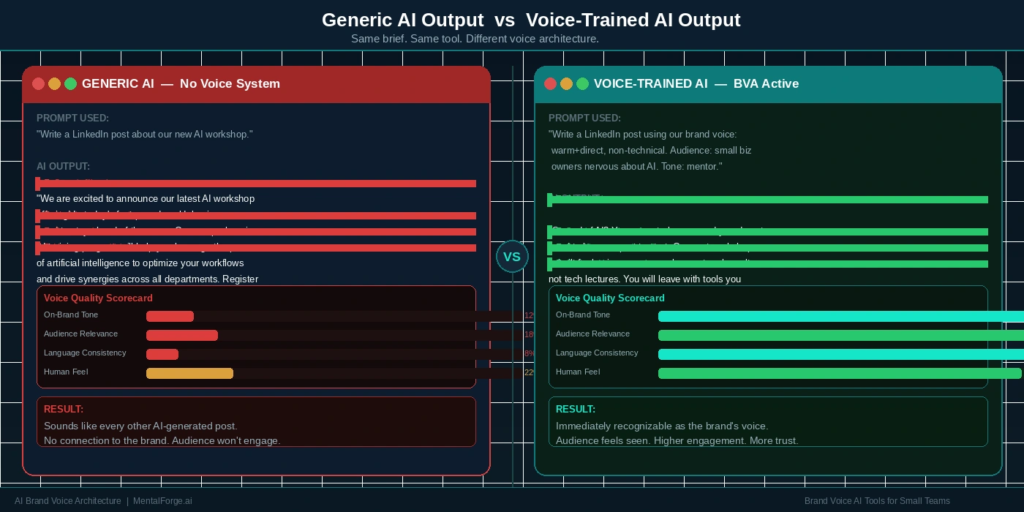
Generic AI vs. Voice-Trained AI: The Output Gap
When you ask an AI to "write a friendly LinkedIn post about our new service," you get something serviceable. When you ask an AI to "write a friendly LinkedIn post about our new service, using our brand voice pillars, avoiding corporate jargon, and addressing small business owners who feel nervous about technology," you get something that sounds like your brand.
The difference is not just in prompt length. It is in how much structured voice information you have prepared before you type that prompt.
Setting Up Your AI With Brand Voice Parameters
Here is what good AI voice training looks like in practice. Before using any AI writing tool, you feed it the following:
- Your 3 to 5 tone words and what each one means in practice
- Sample sentences that represent your voice at its best
- A short list of words and phrases your brand never uses
- The type of reader you are always writing for
- The feeling you want content to leave the reader with
With these inputs saved as custom instructions or reusable prompt templates, every piece of content your team produces with AI integration tools starts from the same voice foundation. Consistency becomes built into the process rather than something you chase after the fact.
4 AI Tools Small Teams Are Using to Stay On-Brand
Small teams do not need a dozen tools. They need a few well-configured ones.
For Content Writing With Consistent Tone
ChatGPT with Custom Instructions lets you store brand voice details directly in the settings, so every conversation starts with your voice parameters already loaded. Claude by Anthropic performs especially well for longer-form content where nuanced tone matters. Jasper was built specifically for marketing teams and includes brand voice saving as a native feature.
For Documentation and Style Guide Management
Notion AI works well as a living brand voice hub. Teams can store voice guidelines, prompt templates, and sample content all in one searchable workspace. Copy.ai includes a brand voice tool that lets you upload sample content and extract consistent tone patterns automatically.
Table 2: AI Brand Voice Tools Comparison for Small Teams
| Tool | Best For | Voice Customization | Team Size Fit |
| ChatGPT (Custom Instructions) | General content creation | High | Solo to small team |
| Claude by Anthropic | Long-form and nuanced writing | High | Small to mid-size |
| Jasper | Marketing copy at volume | Built-in feature | Small to mid-size |
| Notion AI | Voice documentation and storage | Moderate | Any size |
| Copy.ai | Extracting voice from existing content | Built-in feature | Solo to small team |
A Practical Framework for Building Your Brand Voice System With AI
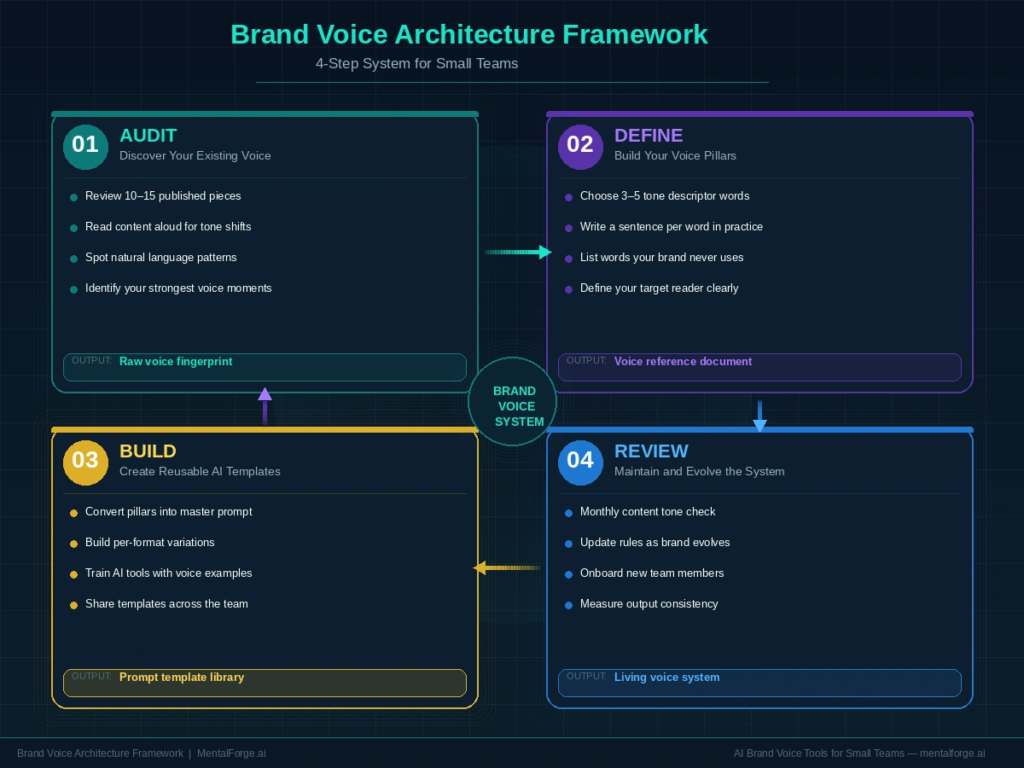
You do not need months to build this. Most small teams can set up a working brand voice system in a focused week. Here is the process.
Step 1: Audit What You Already Sound Like
Pull together 10 to 15 pieces of content your team has already published. Read them out loud. Notice where the tone shifts, where certain words keep appearing, and where the writing sounds most like your brand at its best. This gives you raw material to work with.
Step 2: Define Your Voice Pillars and Language Rules
From that audit, identify 3 to 5 words that best describe your brand's communication style. For each word, write one sentence explaining what it means in practice. Then add a short list of phrases your brand never uses. This becomes your voice reference document.
Step 3: Build Prompt Templates Your Team Can Reuse
Take your voice pillars and translate them into a master prompt template. Every team member and every AI tool starts from this template. You can create variations for different content types such as emails, social posts, and blog articles. But the core voice parameters stay consistent across all of them.
Step 4: Set a Monthly Review Cycle
Brand voice is not static. As your brand grows and your audience evolves, your voice should grow with it. Set a monthly reminder to review recent content, check for tone drift, and update your templates if needed. This is what keeps a brand voice system alive rather than turning it into another forgotten document.
The Biggest Mistakes Small Teams Make With AI Brand Voice Tools
Using AI Without a Voice Foundation First
The most common mistake is reaching for AI tools before defining the brand voice they are supposed to carry. Without that foundation, AI produces content that is technically correct but emotionally hollow. The output looks like writing. It just does not sound like your brand.
Treating the Style Guide as a One-Time Document
A brand voice guide written in January and never updated does not reflect the brand by July. Voice systems only work when they are actively maintained. Think of it less like a rulebook and more like a living reference your team returns to regularly.
Forgetting That New Team Members Need the System Too
When someone new joins the team, they inherit whatever communication habits they bring with them. A well-documented voice system closes that gap and gets new contributors aligned much faster. A clear guide on how small businesses can start AI integration without technical knowledge can also help new team members build AI confidence quickly alongside the brand voice system.
How MentalForge Helps Teams Build This Without the Overwhelm
Building a brand voice system from scratch takes clarity, structure, and honest self-reflection. Many small teams get stuck because they either overthink the process or skip the foundational steps entirely.
MentalForge's Brand Voice Architecture service guides teams through the full process, from voice discovery to implementation. Rather than handing over a template, the BVA process uncovers the authentic voice already present in the brand and builds a repeatable system around it.
For teams that also want to build practical AI skills across the whole business, the Fusion Foundation workshop covers how to use AI for content, email, presentations, and daily productivity. It is built specifically for professionals who want real skills without the technical overwhelm.
From Scattered to Strategic: What the Process Looks Like
Teams that go through a structured brand voice process typically see three things happen quickly. First, content production speeds up because writers have clear direction. Second, the brand starts to feel more trustworthy because the messaging is consistent. Third, AI tools become genuinely useful because they have proper inputs to work with.
The shift is not dramatic. It is just steady. One consistent message. One recognizable voice. Everywhere your brand shows up.
Your Brand Voice Is Already There. AI Just Helps You Scale It.
Your brand has a voice. It lives in the way you talk to your best customers, the words you naturally reach for, and the tone that feels most honest to who you are.
The challenge is not finding that voice. It is capturing it clearly enough that every team member and every AI tool can carry it forward without losing it.
That is what brand voice architecture does. It takes something that lives in your instincts and turns it into a system that scales.
If you are ready to stop sounding like three different brands and start showing up as one, the process starts with a clear audit, a simple framework, and the right tools behind them.
| Ready to Build Your Brand Voice System? Book a consultation with MentalForge and start building a voice your team and your AI tools can follow. |