
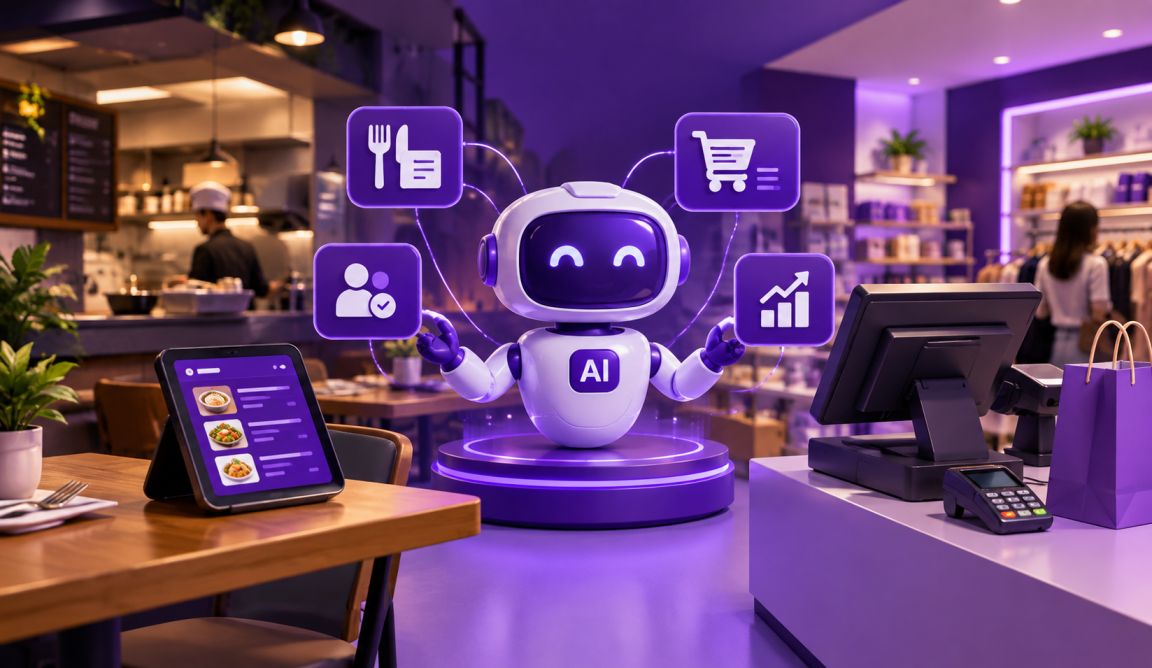
Most of what gets written about AI automation for small business skips two industries that actually have the clearest use case for it: restaurants and retail. Thin margins, high staff turnover, customer volume that spikes and drops by the hour, and a dozen small repetitive tasks that eat time nobody has to spare. If you run either kind of business in North Texas and you've read our automation content for healthcare practices or home service companies and wondered whether any of it applies to you, here's the honest version, including the parts that aren't worth automating yet.
Two Different Businesses, One Shared Problem
A restaurant and a retail shop don't look alike on the surface, but they share a structural issue: a large share of daily operations is repetitive, time-sensitive, and currently handled manually by people who are already stretched thin. Answering the same delivery questions all night. Reordering the same fast-moving inventory item every week, sometimes late. Following up with a customer who almost bought something and didn't. None of that requires creativity or judgment. All of it requires consistency, which is exactly what automation is good at and what a busy staff often isn't, not because they're careless, but because they're doing six things at once.
Where It Pays Off in a Restaurant
Restaurant adoption of AI is still early. According to the National Restaurant Association's State of the Restaurant Industry 2026 report, about a quarter of restaurant operators are currently using AI-related tools, with marketing being the leading use case, followed by administrative tasks. That leaves a lot of room, and a few specific areas where the return is clear:
- Order and reservation handling after hours. A missed call during dinner rush or a question that comes in after close is a lost booking. Automated handling of routine order and reservation questions closes that gap without adding staff.
- Inventory reordering for fast-moving items. Automated alerts tied to actual usage patterns catch a low stock situation before it becomes a Friday night scramble.
- Review and feedback follow-up. A short automated message after a visit, asking about the experience and prompting a review when it went well, is a small thing that consistently gets skipped when a shift is short-staffed.
What's less proven, and worth being honest about: full kitchen automation, robotic prep, and AI-driven customer orders are still low-adoption even among large chains. Only about 6 percent of restaurants are currently using AI for customer orders. For an independent restaurant in North Texas, that's not where the near-term value is. The value is in the back-office and follow-up work that's invisible to customers but eats real staff time.
Where It Pays Off in Retail
Retail's pressure points look different but land in the same place: too many small, repeatable tasks and not enough hours to do them consistently.
- Inventory and restock alerts. Knowing a top seller is about to run out before it actually does, rather than after a customer asks for something you don't have.
- Post-purchase follow-up. A simple automated check-in after a purchase, or a reminder when someone abandons a cart online, recovers sales that would otherwise just disappear.
- Customer segmentation for promotions. Instead of sending the same offer to everyone, automation can group customers by what they actually buy and when, so a promotion goes to people likely to respond to it.
Retail overall is under real competitive pressure this year. The National Retail Federation forecasts that U.S. retail sales will grow 4.4 percent in 2026 to $5.6 trillion, which sounds like good news until you consider that most of that growth is being captured by retailers who are already operationally tighter than their competitors. Independent shops in North Texas aren't competing with each other so much as they're competing with the convenience customers now expect from everyone.
What's Not Worth Automating Yet
Not every task is a good automation candidate, and it's worth saying that plainly rather than pretending everything can be handed off to a system.
- Anything requiring in-person judgment, like reading whether a customer wants help or wants to be left alone on the sales floor
- Complex custom orders or accommodations that don't follow a pattern
- Situations where the "human touch" is the actual product, which is true for a lot of independent restaurants and boutique retailers
Automating the wrong things doesn't just waste money. It can strip out the parts of the experience that made a customer choose an independent business over a chain in the first place.
Starting Without Overhauling Everything
The businesses that get the most out of automation don't try to fix everything in one pass. A more workable approach:
- Pick the single most repetitive task in your operation. For a restaurant, that's often after-hours order and reservation questions. For retail, it's usually inventory or post-purchase follow-up.
- Automate that one thing and watch what changes for a few weeks. Not just whether it saved time, but whether the quality held up.
- Connect it to what you already use. A tool that doesn't talk to your POS or your existing customer list creates more manual work, not less.
- Add the next piece once the first one is actually running smoothly, rather than stacking three new systems on your team at once.
That sequencing matters more than which specific tool you pick first. A lot of automation projects fail not because the technology doesn't work, but because too much changed at once for the staff running day-to-day operations to keep up.
If you're trying to figure out which piece of your operation is worth automating first, that's usually a conversation worth having before you buy anything. Our AI automation services are built around exactly that kind of assessment: starting with the actual bottleneck in your business rather than a generic package of features that may not fit how a restaurant or retail operation actually runs day to day.
North Texas restaurants and retailers are dealing with the same labor and margin pressure as everywhere else, but the fix isn't wall-to-wall automation. It's finding the two or three repetitive tasks quietly costing you the most time each week and fixing those first.